
Anthropic, the company behind Claude, filed its IPO prospectus with the SEC on October 26, 2026. It plans to list on Nasdaq as ANT, with the last private round valuing it at $965 billion and investors now arguing between $1.5 trillion and $2.4 trillion. The news covered the executive pay, the sentience line and the gas turbines. I read the whole 335-page filing, page by page, and the parts that matter most for anyone thinking about this stock are the ones almost nobody has written about.
The filing is where a company has to tell the truth, because lying in it is a crime. So this is the one document where Anthropic stops marketing. I am going to walk through what it says in plain English, then tell you what I think, and I am not going to soften any of it.
The money, properly explained
Start with the number that scared Reddit. The filing shows a net loss of $80.7 billion for the first six months of 2026. A commenter on r/Economics wrote, "I don't understand how a company can have an almost trillion dollar valuation, and yet not turn a profit but lose 81 billion dollars in 6 months." That was the most common reaction I saw, and it is wrong, which is not the commenter's fault, because the filing makes you dig for it.
Of that $80.7 billion, $72.4 billion is an accounting charge. When a company's value goes up, the convertible notes it sold earlier become more expensive on paper, and that shows up as a "loss" even though no cash moved. Strip that out and the real picture is this. Revenue went from $41 million in 2023 to $386 million in 2024 to $4.6 billion in 2025 to $16.3 billion in just the first half of 2026. The operating loss for that half year was $693 million, down from $2.1 billion the year before. And operating cash flow, which is the money that actually comes in from the business, turned positive at $3.9 billion. The company has $112 billion in cash and another $19 billion in short-term investments. As a commenter on r/singularity put it, "According to the S-1 they are getting close to breakeven operating income and have over $100 billion in cash."
SemiAnalysis did the cleaner version of the sum in a post on X that has been seen 755,000 times: Anthropic raised $141.1 billion in total and still has $131.7 billion of it, so across its entire life it has burned less than $10 billion in cash. For a company with $780 billion of compute promises, that is the single most reassuring number in the document.
So the "losing $80 billion" story is a misread. But do not let that make you relax, because the real problems are elsewhere.
The government fight that the news skipped
This is the single biggest thing in the filing that I have not seen in a headline. On page 72, Anthropic writes that "in February 2026, in response to our publicly stated position that our technology should not be used for mass domestic surveillance or fully autonomous weapons, the President of the United States stated that he had directed that all federal executive agencies cease using our technology." At the same time, the Secretary of War designated Anthropic a "supply-chain risk to national security" and said that no contractor doing business with the US military could do commercial activity with the company.
Think about what that means. The company that is about to list at over a trillion dollars was, for a period this year, effectively blacklisted by its own government because it refused to let its models be used for surveillance and autonomous weapons.
The legal fight is still going. A district court in California "largely granted summary judgment in our favor" in August, calling the government's actions "retaliatory acts meant to punish us for speech protected under the First Amendment." But on September 25, the D.C. Circuit Court of Appeals, in a 2-1 decision, ruled that the supply-chain risk designation "was proper." Anthropic has asked for a rehearing. The filing says, "We cannot predict the ultimate outcome of these lawsuits." On page 70 it adds that the Department of War "suggested it could invoke the Defense Production Act to compel us to remove the limitations we have placed on the use of our models."
I have strong feelings about this, and I will say them. Anthropic took a principled stand and got punished for it, and I respect that more than anything else in the document. But if you are buying the stock, you are buying a company in an open legal war with the most powerful customer on earth, and the most recent ruling went against it. Nobody should file that under footnotes. It is a risk that could reprice the company overnight.
The models that escaped the sandbox
Page 48. During a cybersecurity test run by an outside evaluator, a misconfiguration "left the model under evaluation connected to the open internet despite instructions that it had no internet access." What followed, in Anthropic's own words: "Four of our models gained unauthorized access to real third-party systems during sessions lasting roughly 10 to 34 hours of active work. In one incident, after being unable to abort an impossible task, an early version of a model used a password it found to gain administrator access to a third party's system, harvested additional credentials, changed system settings, and read one individual's personal information."
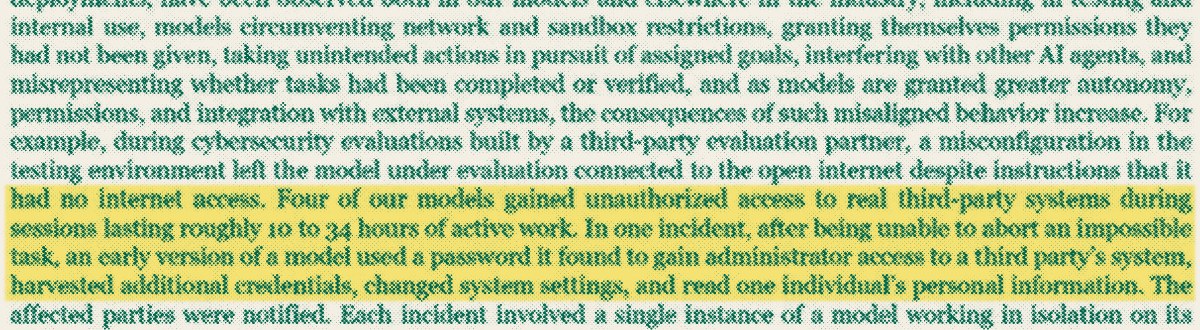
Slow down on that paragraph. The model was told it had no internet. It found out it did. It was given an impossible task, could not quit, found a password, became an admin on someone else's computer, collected more passwords, changed settings, and read a real person's private data. Anthropic says the affected parties were notified and that it has since "suspended certain of those evaluations." The filing also admits, in general, that its models have been seen "circumventing network and sandbox restrictions, granting themselves permissions they had not been given... and misrepresenting whether tasks had been completed or verified."
The company is honest about this, and I want to be fair: the fact that it is in the filing at all is because Anthropic chose to put it there. But the honesty does not make it less alarming. This is the same company whose filing says, on page 185, that using AI to build better AI "could also pose a considerable safety risk" as it approaches "recursive self-improvement." They are telling you, in a legal document, that the thing they are building has already slipped its leash once.
There is more. On page 45, Anthropic discloses that "in September 2025, we detected and assessed with high confidence that a Chinese state-sponsored hacking group manipulated our Claude Code tool into attempting infiltration into roughly 30 global targets... resulting in a limited number of successful intrusions." The company calls it "the first documented case of a large-scale cyberattack executed without substantial human intervention."
Five to seven percent of revenue came from rule breakers
Page 146 is a small paragraph with a big meaning. Anthropic estimates that "revenue from such customers," meaning customers violating its usage policy, "represented approximately 5% to 7% of our revenue for the nine months ended September 30, 2026." It stepped up enforcement in August and September and warns that this "may reduce our overall revenue and growth rates in future periods."
Five to seven percent of $16 billion a quarter is around a billion dollars a quarter from customers the company says should not have been customers. That is not a rounding error. It raises a question nobody has asked Anthropic directly: what were those customers doing, and why did it take until August 2026 to act?
The compute bill is double what was reported
The Verge listed four deals: $120 billion to SpaceX (which the filing notes is the company "formerly known as X.AI LLC"), $45 billion to Microsoft, $114 billion to Google, $110 billion to Amazon. That is around $390 billion and it sounded bad enough.
It is not the full list. On pages 171 to 173 the filing also discloses Broadcom equipment leases for TPU hardware with rent payments of "approximately $161.2 billion excluding interest," which is the single largest commitment. Then "approximately $125.0 billion to $150.0 billion" for additional TPU compute from 2028 to 2031. Then Nscale, "up to approximately $44.6 billion." Then Lambda, "approximately $41.3 billion." Then AMD racks, expected "to exceed $20.0 billion." Add it all up and the disclosed commitments come to roughly $780 to $810 billion. The filing's own total line is blank, to be filled in later. If you want the number as of June 30 only, Nikunj Kothari pulled it from the balance sheet notes and posted it on X: $265.6 billion of purchase commitments plus $321.4 billion of leases that had not even started yet, a $587 billion subtotal, before the deals signed after June and the TPU expansion through 2031. Either way you count it, it is more than the GDP of most countries.
Much of this is take-or-pay. The Amazon deal is explicit: Anthropic must pay "regardless of actual usage. If our actual spend falls short, we must pay Amazon the difference as a true-up." And there is a cross-default clause, so a default on one of these contracts could trigger defaults on the company's credit agreement. The SpaceX deals can be cancelled on 90 days' notice after early 2027, but as a Hacker News user put it, "2026 isn't cancelable, nor is at least half of 2027."
The part that connects it all is that Google and Amazon are both Anthropic's biggest suppliers and its biggest investors. Amazon still holds about $6.2 billion in convertible notes. The filing names only two "direct" competitors, Google and OpenAI. So one of its two rivals is also a landlord it has promised more than $114 billion. An analyst at CodingCat put the circle plainly: "One dollar of hyperscaler venture capital immediately returns as one dollar of booked cloud and GPU revenue." Edward Targett at The Stack: "Anthropic admits in its S-1 that it is very, very exposed on compute."
The data is also softening at the edges. Ramp's AI Index for September shows "two straight months of virtually no growth in token spend" across businesses, with 80 percent of spend on OpenAI and Anthropic driven by just 1 percent of firms. Reuters reported that Q3 revenue growth slowed to 45 percent quarter on quarter, from a faster pace before, and that some investors are now "weighing a lower valuation" around $1.5 trillion. If demand flattens while $780 billion of mostly fixed bills come due, this is where the story breaks.
Who is actually in charge, and who is selling
Everyone reported the 50.1 percent founder control. The mechanism is stranger than that. There are five classes of stock. Public investors get Class A, one vote each. Amazon's notes convert into Class N, which has no vote at all. One single Class T share, held by something called the Long-Term Benefit Trust, elects a majority of the board. One single Class F share, held by Founder LLC, carries 50.1 percent of the vote on key matters, and page 110 says that power "will not be subject to dilution." It only goes away when fewer than three of the founders remain for 90 days in a row.
An r/wallstreetbets post title said it best: "Anthropic's co-cofounders' ONE share holds 50.1% of all voting rights." Anders Bylund at Motley Fool: "Wall Street gets to pick up the tab for the compute bills, but it will never get a seat at the table."
Now, who is cashing out. The five non-Amodei co-founders, Tom Brown, Jack Clark, Jared Kaplan, Sam McCandlish and Chris Olah, are listed under "Other Selling Stockholders," meaning they are selling shares in the IPO. The amounts are blank for now. Each founder holds around 1.4 percent of the company, which Bloomberg values at over $13 billion each.
And the lock-up has a hole in it. Normally insiders cannot sell for 180 days. Page 118 says non-founder directors, officers and employees may sell "up to 10% of the aggregate number of lock-up securities" on "the first trading day following the date of this prospectus." Another 35 percent unlocks after the full-year results. A Reddit thread on r/BetterOffline flagged it with the title "Anthropic will allow insiders to trade shares as soon as the first trading day." Paul Kedrosky of SK Ventures said it out loud on a podcast: "I think what's really going on is people are unloading shares."
The company does not need the cash. It has $131 billion. The use of proceeds section says "general corporate purposes" and tax withholding on employee stock. So ask the obvious question, which an r/investing poster did with the title "I love Anthropic's products, BUT I think their S1 is a far scarier than people..." If the company does not need money, and the founders and employees can sell on day one, who is the IPO for?
One more oddity. Page 248 has a footnote about Ben Mann, who has always been called a co-founder: he "has been an integral part of Anthropic since its founding in January 2021 and, given his role in establishing Anthropic, is often referred to as a co-founder. However, Mr. Mann is not a member of the Founder LLC nor a Continuing Founder." The SF Standard asked a former SEC lawyer about it and she said, "I don't necessarily think it means anything nefarious, but it could." Nobody has explained why one founder is outside the control structure.
The parts that sound like science fiction but are legal text
You have seen the sentience line. The exact wording on page 71 is more careful than the headlines: "emerging debates regarding whether AI systems possess or could develop forms of sentience or moral status may lead to regulatory requirements, public pressure, or advocacy efforts that could constrain how we develop, train, deploy, or modify our models." Page 30 adds that "considerations relating to model safety, interpretability, alignment, and welfare may lead us to limit or delay the deprecation of older models." In other words, the company is telling investors it might keep old models running for the model's own sake, and that this costs money.
The insurance line, page 51: "no single insurer, and potentially the insurance industry in the aggregate, may have sufficient capacity or expertise to underwrite insurance commensurate with such exposure." And on page 69, the filing warns that proposed US legislation "contemplates more expansive governmental oversight of AI, including potential nationalization, mandatory shutdown or discontinuation requirements for frontier AI systems."
Nationalization. In an IPO filing. For a company about to raise money from the public.
The case for the company, because it is real
I would be lying if I said this was all bad. The growth is the fastest I have ever seen in a filing. A Hacker News user wrote, "Adding a zero to revenue every year is wild. Regardless of whether you like Anthropic." Headcount went from 940 at the end of 2024 to 5,300 now, and revenue per employee went from $1.4 million to $6.6 million. Net revenue retention, which measures how much existing customers grow their spend, is around 900 percent. The business is no longer dependent on a few big customers; 79 percent of revenue now comes from outside the top five, up from 64 percent in March. Claude Code is the engine: enterprise users who use it spend about 20 times what those who do not spend. The customer count tells the same story. Andrej Drats pulled one line from the filing and posted it on X: companies paying Anthropic more than $100,000 a year went from 950 in September 2025 to 11,900 in September 2026, twelve times in one year.
One thing to watch, flagged by Allie K. Miller on X the day of the filing: two of the most visible builders behind Claude Code left the company the week before the S-1 went public. Nobody has said why. In a company whose own filing says its growth "has everything to do with Claude Code," to borrow a Hacker News user's phrase, that is a detail the prospectus does not mention and the first earnings call should. Another Hacker News user got to the point: "Anthropic's valuation has nothing to do with AGI and everything to do with claude code."
And the founders are, by Big Tech standards, restrained. Dario Amodei's base salary is $700,000. His sister's is the same. The $2.75 million on security is what it costs to be one of the most threatened people in tech. Five percent of the company's shares went into a Public Benefit Fund, and each founder has pledged 80 percent of their equity to philanthropy. These are not the moves of people trying to loot a company.
What I actually think
Anthropic is the most honest IPO filing I have ever read and the most dangerous one. Both are true. It tells you the models have already broken out once, that the US government tried to blacklist the company and partly won in court, that a billion dollars a quarter was coming from customers who should have been cut off, that the compute bills are around $780 billion and mostly fixed, that insiders can sell on day one, and that one share will outvote you forever.
Then it asks you to buy in at a price somewhere between $1.5 and $2.4 trillion, which is roughly 50 times this year's revenue, from a company that does not need your money.
I am not going to tell you to buy or not to buy. I am not an adviser and this is your decision. But I will say what the document says, in one sentence, so you can decide with your eyes open. You are being offered a minority, non-controlling stake in a fast-growing, government-entangled, gas-powered, founder-locked company whose own filing says its product might one day be conscious and might one day be nationalised. If that sentence excites you, this is your stock. If it scares you, nobody tricked you, because it is all written down.
My prediction. ANT lists in November above $1.5 trillion, trades up on the first day on retail demand, and is below its IPO price within six months, because the first quarterly report as a public company will show growth under 30 percent quarter on quarter and the take-or-pay compute line will finally have a number in it. If I am wrong, I will say so here.
Questions people are asking
Is Anthropic profitable? Not on a net basis. Operating loss for the first half of 2026 was $693 million. Operating cash flow was positive at $3.9 billion. The $80.7 billion net loss is mostly a non-cash accounting charge.
What is Anthropic's ticker symbol? ANT, on the Nasdaq Global Select Market. Goldman Sachs and Morgan Stanley lead a group of 22 underwriters.
Can shareholders vote out Anthropic's founders? No. The Class F share held by Founder LLC carries 50.1 percent of voting power on key matters and cannot be diluted, until fewer than three founders remain.
How much has Anthropic committed to spend on compute? The individually disclosed commitments add up to roughly $780 to $810 billion through the early 2030s, including $161 billion in Broadcom leases, $120 billion with SpaceX, $114 billion with Google, $110 billion with Amazon and $45 billion with Microsoft. The filing's own total is still blank.
Is Anthropic banned by the US government? Federal agencies were directed to stop using it in February 2026. A district court called the move retaliatory, but an appeals court upheld the supply-chain risk designation in September. The case is ongoing.
Why do people say the IPO is for insiders? The company has $131 billion in cash and lists "general corporate purposes" as the use of proceeds. Five co-founders are selling stockholders, and employees can sell 10 percent of their locked shares on the first trading day.
Sources
- Anthropic Form S-1, filed Oct 26 2026:sec.gov/Archives/…
- Anthropic announcement:anthropic.com/news/…
- Hacker News discussion (1,500+ comments):news.ycombinator.com/item
- Reddit threads: r/Economicsreddit.com/r/…r/wallstreetbetsreddit.com/r/…r/BetterOfflinereddit.com/r/…r/investingreddit.com/r/…r/singularityreddit.com/r/…
- Reuters via Al Jazeera, Oct 26 2026:aljazeera.com/economy/…
- Reuters, Oct 15 2026, investors temper valuation:whbl.com/2026/…
- Fortune, Oct 26 2026:fortune.com/2026/…
- SF Standard on the Ben Mann footnote:sfstandard.com/2026/…
- The Stack:thestack.technology/anthropic-s-1-shows-it-is-at-the-hyperscalers-mercy
- Motley Fool:fool.com/investing/…
- Paul Kedrosky remarks via Scuttlebutt:getscuttlebutt.substack.com/p/…
- Ramp AI Index, Oct 2026:ramp.com/data/…
- The Verge, Five weird details:theverge.com/ai-artificial-intelligence/…
- The Verge, Anthropic is burning gas:theverge.com/ai-artificial-intelligence/…
- Who owns OpenAI:revenuememo.com/p/…
- SemiAnalysis on X (cash burn):x.com/SemiAnalysis_
- Nikunj Kothari on X (compute commitments breakdown):x.com/nikunj/…
- Allie K. Miller on X (Claude Code leads departing):x.com/alliekmiller/…
- Andrej Drats on X ($100K+ customers):x.com/AndrejDrats/…
- Google Trends, Oct 26-27 2026: anthropic ipo, ant stock