On 27 October, an engineer called Orestis Ioannou published a short blog post with a title that a lot of people felt in their bones: "AI Promised Less Work. I Have Never Worked More." He leads engineering at Bold.org, a US scholarship platform, and he uses AI agents for all of his engineering work. His post reached the front page of Hacker News, with about 650 points and 646 comments. It ends with this line: "being able to do more keeps turning into doing more. And I am tired."
I read his post and his replies in the Hacker News thread. I also read Anthropic's own reports on how AI changed work inside the company, and every large study on AI and working hours I could find. They tell a more precise story than the headline. The best data we have shows little change in measured weekday hours. What it does show is work moving into weekends, breaks and evenings, and the work itself getting wider and faster, which costs us attention more than time. In India, where people already argue about 70 and 90-hour weeks, that difference matters a lot.
What he actually describes
Ioannou's old week, as a full-stack engineer, had two or three serious tasks, a feature or a tricky bug, and he could hold one in his head at a time. Today he runs several AI agents in parallel. One builds a change, one looks into a production problem, and others review code or do research. His best line describes the problem exactly: "None of them needs me all the time. Every one of them needs me sometimes."
Each time an agent comes back with a question, a plan to approve or a result to check, he has to reload a different problem in his head. He also describes working in bursts. A new model or workflow makes something possible, and his head fills with ideas. Then, as he puts it, "implementation is now cheap, there is no natural friction stopping me from pursuing all of them at once." After a few weeks, the reviewing and switching catch up with him and he pulls back, until the next burst. He counts three of these cycles since January.
His own data says something more interesting
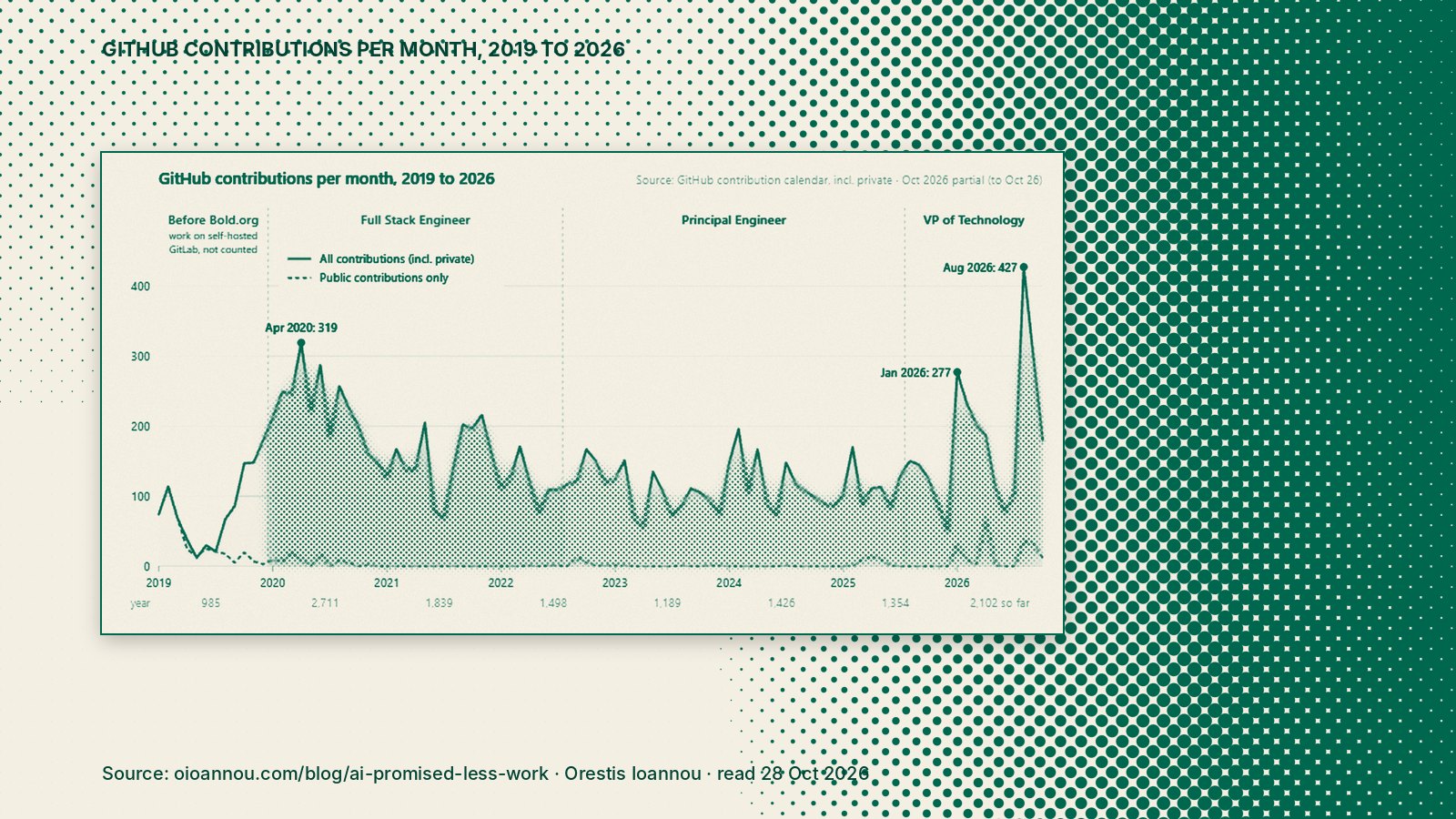
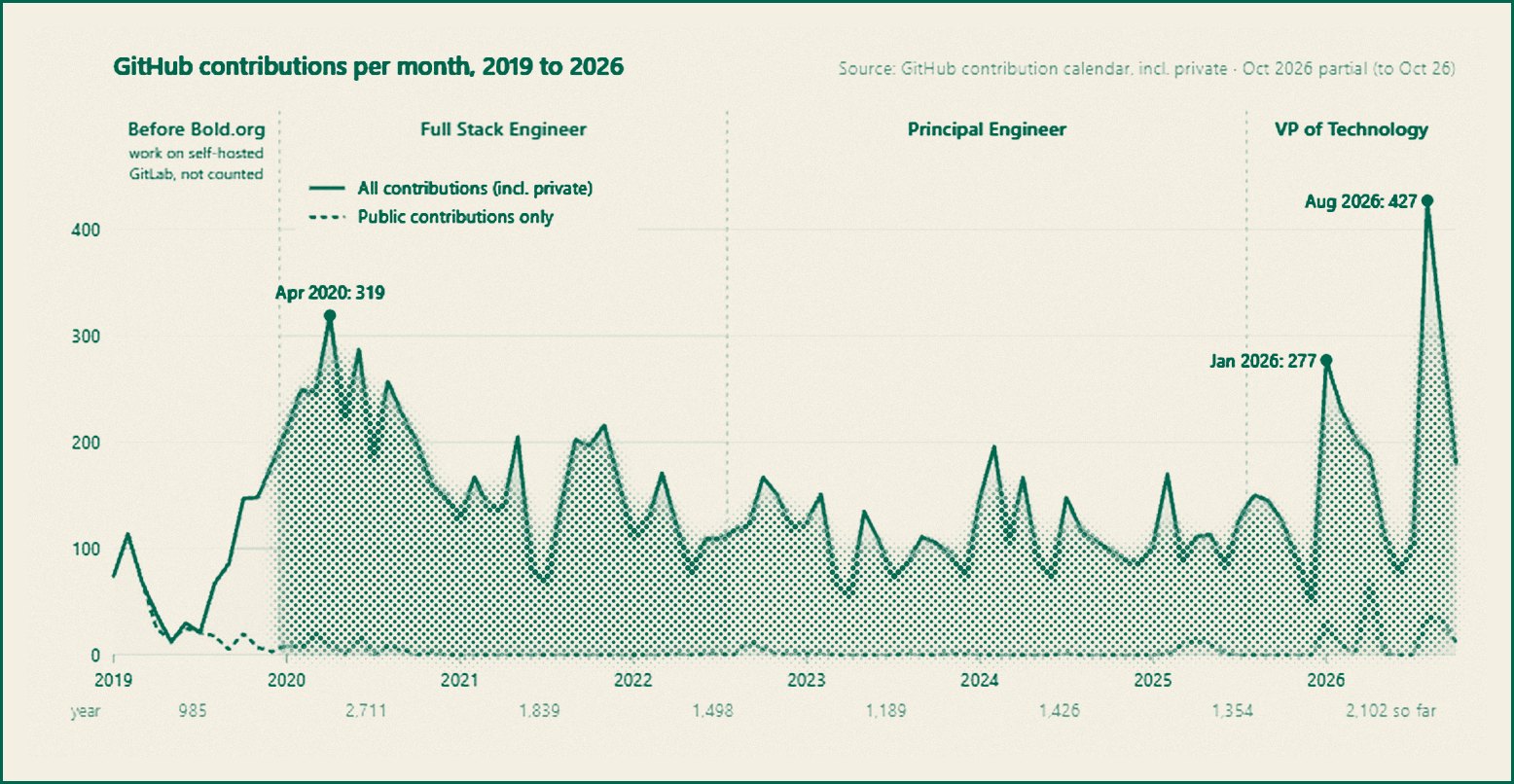
Ioannou pulled his GitHub history to back up the feeling, and to his credit, he shows the numbers that don't fit the headline. August 2026 was his busiest month in a record that starts in 2019, with 427 contributions, well above his old record of 319 in April 2020. His normal weekday went from 3 or 4 contributions to 7. But by 27 October, his total for 2026 was 2,102, which is still below the 2,371 he had reached by the same date in 2020. He also calls the counts "a rough signal of activity, not a measure of value."
In the Hacker News thread, he said he feels his hours did go up, "not just my output". New ideas keep filling the extra capacity, and he can run them from his phone. "Its not that i am required to be physically all the time on my pc more," he wrote. "Its that i get to be more hours engaged?" He also said nobody on his team was cut. A lot of his new work is tickets that used to sit "in the drawer", like small bugs and old code debt. So his story isn't about a boss demanding longer days. It is about a person who can now do more and keeps saying yes to himself.
What the bigger data shows about hours
The large studies line up with his numbers more than with his title. The St. Louis Fed has tracked AI at work in the US since 2024, and by mid-2026, US workers said AI saved them about 2.2 percent of all work hours. A Danish study that matched 2023 and 2024 survey answers to official job records found that AI chatbots had "no significant impact on earnings or recorded hours in any occupation." ActivTrak sells workplace monitoring software, and it measured 163,638 employees. It found the average weekday actually got shorter, from 8 hours 53 minutes in 2023 to 8 hours 44 minutes in 2025. The same data shows weekend work jumping, though, with Saturday hours up 46 percent and Sunday hours up 58 percent. ActivTrak doesn't say AI caused either change.
So measured weekday hours haven't grown much, while weekends have filled up. The work has changed shape instead, and the best study of that shape comes from Berkeley's business school. Researchers Aruna Ranganathan and Xingqi Maggie Ye spent eight months inside a US tech company of about 200 people, which didn't force anyone to use AI. They found that people worked at a faster pace and took on a broader range of tasks. They also stretched work into more hours of the day, "often without being asked to do so". People sent prompts during lunch, before meetings and in the evening when an idea came to mind. One of the researchers, Xingqi Maggie Ye, warned that over time, "what was once extra effort becomes standard performance".
Anthropic's own numbers show the same thing from the inside. In a survey of 132 of its engineers and researchers in August 2025, people estimated that 27 percent of their AI-assisted work "wouldn't have been done without it". That is new work, not time saved. And in a report on 16 October, Anthropic found that its staff spend 20 percent more time in meetings than a year earlier, partly because the company grew. It also found that its staff's Claude sessions spend "around 80% idly waiting for human input."
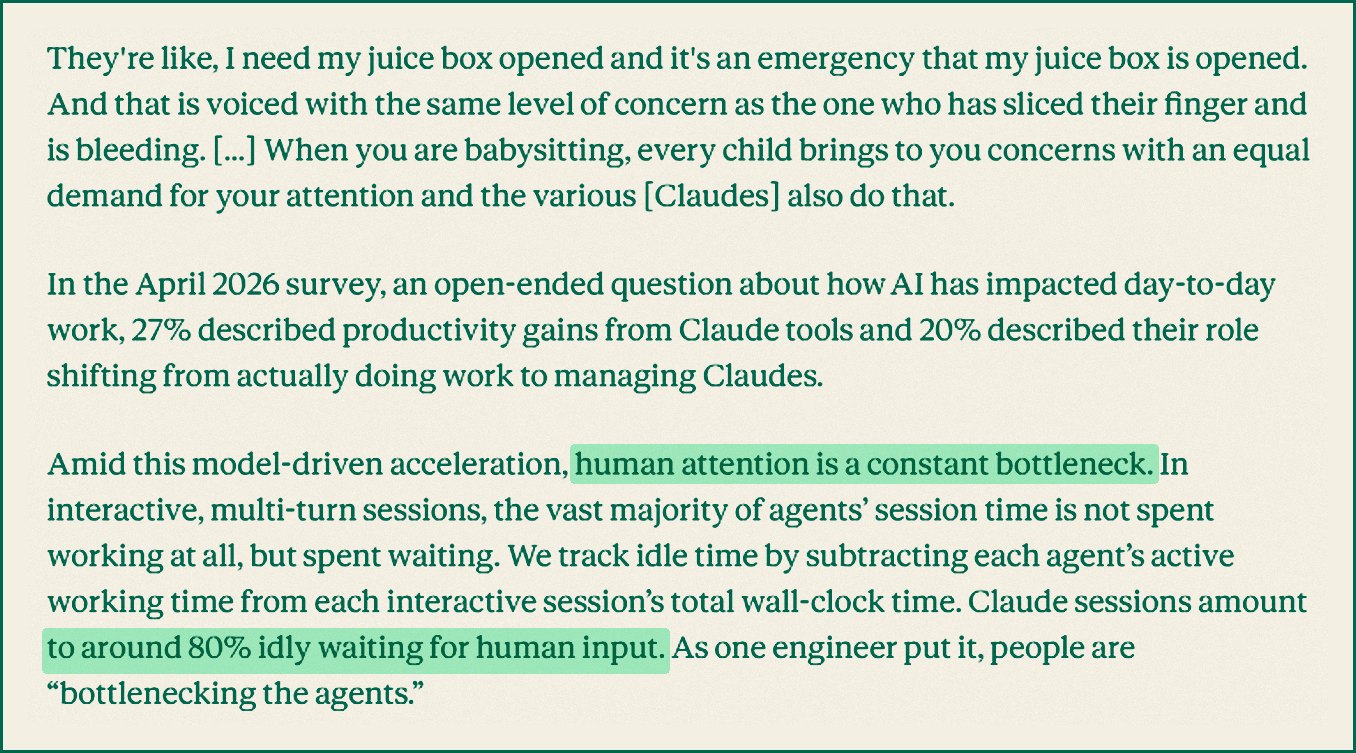
One Anthropic engineer described it like babysitting. Every agent brings its problem to you with the same urgency, whether it is a cut finger or an unopened juice box. Another employee described "eternal pressure at Anthropic to move as fast as possible and use Claude for everything". The report never measures how many hours Anthropic's staff work, so we can't check the hours claim even at the company that makes the tool.
We have seen this before
None of this is new, and history has a name for it. In 1865, the economist William Stanley Jevons noticed that more efficient steam engines didn't reduce how much coal Britain used. They increased it, because cheaper power found more uses. He wrote that thinking efficiency means using less "is wholly a confusion of ideas", and that "the very contrary is the truth." Microsoft's CEO Satya Nadella wrote "Jevons paradox strikes again!" about AI last year. When something gets cheaper to produce, we produce much more of it, and code and reports are no different.
In 1930, John Maynard Keynes wrote that within a hundred years, by about 2030, the basic economic problem would be solved or close to it. He said three-hour shifts, or a fifteen-hour week, would help spread out the little work that was left. In 2013, researchers from MIT and UC Irvine found that professionals who got BlackBerry phones saw them as freedom to work "anywhere/anytime", and ended up working "everywhere/all the time". Even washing machines and vacuum cleaners didn't cut housework. The historian Ruth Schwartz Cowan showed that in 1965, American women still spent about as many hours on housework as in 1912, because standards kept rising. Every time a tool makes work cheaper, our expectations rise to eat the gain.
The numbers people keep quoting wrong
Some of the most shared numbers on this topic don't say what people claim. Take the famous Upwork figure that 77 percent of employees say AI added to their workload. It comes from the AI users among just 625 full-time employees in four countries, in a survey run for Upwork, a freelancing platform. It counted anyone who reported any extra burden, including learning the tools. METR's 2025 study, which found developers 19 percent slower with AI, is now out of date by METR's own account. In February 2026, it said developers are "likely" more sped up now. It also said so many developers didn't want to work without AI that its new data was unreliable, so it is redesigning the study. And Microsoft's line about 40 percent of people checking email before 6 a.m. actually describes 40 percent of the people who are already online at 6 a.m.
That doesn't mean the problem is fake. It means the problem is attention and expectation, not a simple count of hours.
The India angle
India walks into this with its hours debate already running hot. In 2023, Infosys co-founder Narayana Murthy said young Indians should be ready to work 70 hours a week. In November 2025, he held up China's "9,9, 6" schedule as an example, which he called "72 hours a week". In January 2025, L&T chairman SN Subrahmanyan was heard in a viral video asking employees, "How long can you stare at your wife?" He also said he was sorry he couldn't make them work on Sundays. Karnataka proposed letting IT firms set 10-hour days in 2025, and dropped the plan after union protests. India's new labour codes allow 12-hour days only in a four-day week, with the 48-hour weekly limit unchanged. The Labour Ministry has made clear that the four-day week is a choice, not a rule.
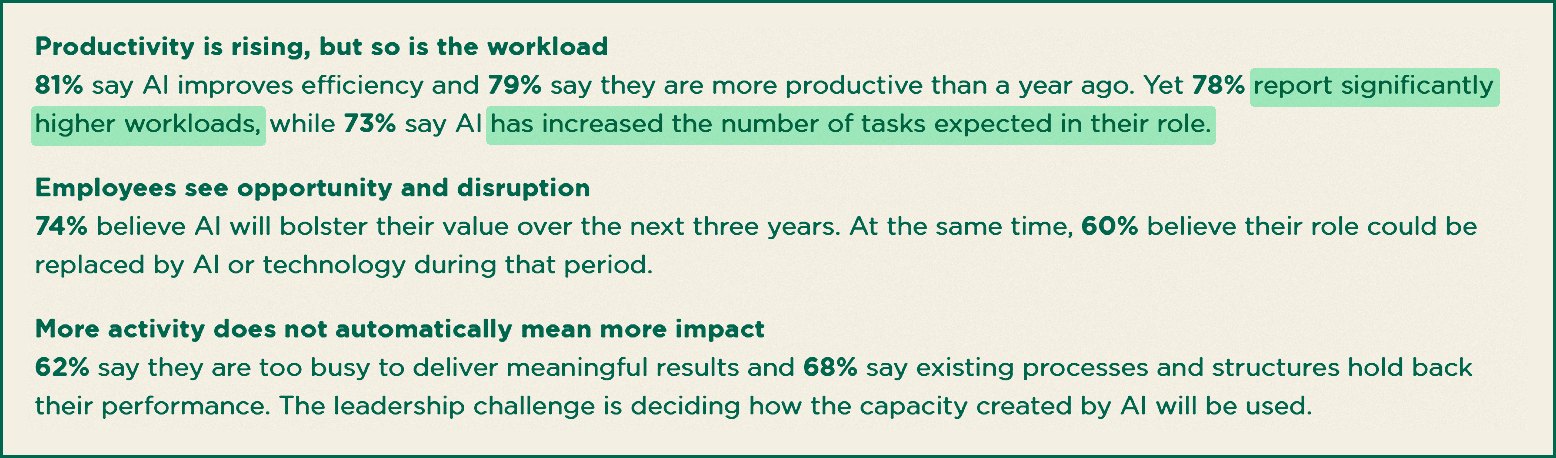
Indian IT workers were already stretched before AI agents arrived. A Blind survey of 1,450 Indian IT professionals in March 2025, which didn't ask about AI, found that one in four worked 70 hours or more a week. 72 percent routinely went over the 48-hour legal limit. In Korn Ferry's Workforce 2026 survey of 2,000 Indian professionals, from staff to CEOs, 78 percent said their workload was significantly higher than two years ago, against 62 percent globally. 73 percent said AI has increased the number of tasks expected in their role. And 70 percent said AI fluency is already part of their performance reviews, against 50 percent globally.
That last number is the one that worries me. Ioannou chose his extra work, but once AI fluency goes into reviews, a choice like his becomes the expected standard. TCS CEO K Krithivasan put the industry's view plainly in February. "Every time there is a disruption, the work expands," he said, and he meant it as good news. In FY26, the year to March 2026, revenue per employee rose about 3 to 4 percent at TCS, Infosys and HCLTech. Over the same year, the five biggest IT firms cut their combined headcount by 7,389. Part of that is AI, and part is layoffs and slower hiring, since TCS blamed its cuts on a skills mismatch, not AI. The question is whether those people get any of the gain back as time or pay.
There is a counterweight in the data too. Great Place To Work India found that burnout levels "have remained broadly unchanged between 2022 and 2026", with 13 percent of employees in the high-burnout group. So AI hasn't broken Indian workers yet. It is raising what counts as a normal day.
What people are saying
The Hacker News thread split into three groups. The first blamed employers, not tools. A commenter called nkrisc wrote, "The opening premise baffles me." "What kind of illusion must one be under to believe that employers would ever pay you the same amount of money to do less work?" The second group recognised the treadmill. A user called sailfast wrote, "I hate it. It's the best time ever to build," and added that the excitement lasted about a year before it became "a treadmill I can't escape". Another, rozap, said he went from one or two tasks at a time to "maybe 10+ things in parallel". He said he works more hours than before, and added, "At the end of the day, my brain is cooked." A user called keiferski described the quality trade-off well. The user wrote that you can now do work at about 80 percent of the old quality in 1 percent of the time. So the result is worse, but "you basically must do it".
The third group pushed back on the whole idea. A small SaaS founder, wolframhempel, wrote that he genuinely works "about 1-2 hours less" and gets more time walking his dog. A solo coder, Razengan, said AI had increased his work in a good way: "This is actually fun." And Grombobulous pointed out that a VP of Technology's experience "is not a typical experience" and told him to delegate.
Back in February, Harvard Business Review published the Berkeley study, and a commenter called asielen summed up the mood in one line. "expectations have tripled, stress has tripled and actual productivity has only gone up by maybe 10%." In July, Sam Altman told the Relentless podcast that we would all be "much busier" after superintelligence but "secretly" happy about it. A Lemmy user called gdog05 answered for a lot of people: "We like to be busy, not exploited".
"People choose this, and many of them enjoy it"
This is the best argument against the whole worry. Measured weekday hours haven't gone up much, and the Berkeley workers stretched their days without being asked to, and many of them found the extra work rewarding. In Anthropic's survey of 81,000 Claude users, most people who said who got the benefit named themselves. Only 10 percent of them said employers or clients were getting more work out of them. Ioannou himself says he likes fixing more things, and he is a VP who picks his own tasks. On this view, AI fatigue is a learning curve for enthusiasts, and it isn't a labour problem.
I think that argument gets the first year right and the second year wrong. Choices that everyone makes turn into norms. The Berkeley researchers warned that this is how extra effort turns into the new normal. Korn Ferry's India numbers show it is already happening in reviews and job expectations. And the cost doesn't need longer hours to be real. Picture an engineer who reviews ten agents' work in eight hours, at 80 percent quality, while answering prompts at lunch. That engineer is more tired than one who wrote one feature in ten hours, even if the timesheet says otherwise. If we only count hours, we will miss this until people break.
Who I'm calling out
My callout goes to TCS CEO K Krithivasan. He says AI will bring more work, not fewer jobs. If that is true, Indian IT companies should tell their employees how much of the gain comes back to them, in time or in money. As AI fluency enters performance reviews across India, TCS should publish a simple rule that AI targets can't push expected hours past the legal 48-hour week. It should also report how revenue per employee and pay per employee moved together. Right now TCS reports revenue per employee and announces pay rises, but it doesn't show the two side by side, so nobody can tell who keeps more of the gain.
My prediction is that the shorter week tech leaders have talked about won't arrive in Indian IT. By 31 December 2027, none of India's five biggest IT companies (TCS, Infosys, HCLTech, Wipro and Tech Mahindra) will cut its standard working week because of AI. If I am wrong, I will say so here.
How to stop AI from eating your attention
You don't have to give up the tools. The people in that thread who sounded happiest had changed how they use them, not stopped.
- Cap how many AI tasks you run at once. If three agents need you sometimes, you are already a manager, and managers need breaks.
- Make a finite list for the day, as one commenter put it, and stop when it is done. The ideas you didn't get to will still be there tomorrow.
- Batch your reviews into set blocks instead of answering each agent the moment it pings.
- Keep lunch and evenings free of prompts, even the ones that are "just a quick prompt", as Ioannou put it.
- If AI fluency is part of your review, ask your manager what it means in outputs, not in hours.
Keynes thought the hard problem of the future would be what to do with all our free time. Four years before his deadline, the problem is the opposite, and the fix starts with deciding where the extra capacity goes before your tools decide for you.
Questions people are asking
Does AI make you work more? There is little evidence that it adds measured hours so far, and US workers report AI saving them about 2.2 percent of work hours. What studies do find is more scope, a faster pace and work spreading into breaks and evenings, often without anyone asking for it.
What is AI fatigue? It is the tiredness people describe from managing AI tools. That means reviewing their output, switching between several AI tasks at once, and taking on more work because AI makes it cheap to start.
Why does using AI make me tired? Mostly because of context switching and review. When several AI agents run at once, each one comes back with something to check, and every switch means reloading a different problem.
Will AI lead to a 4-day work week? It hasn't so far, because we found no big employer that has cut its standard hours because of AI, even though business leaders have talked about shorter weeks. India's labour codes treat a four-day week as an option, not a duty.
Are Indian workers working more because of AI? Many report heavier workloads, and in Korn Ferry's 2026 India survey, 78 percent reported much higher workloads and 73 percent said AI increased the tasks expected of them. Great Place To Work India found burnout broadly unchanged since 2022.
Sources
- Orestis Ioannou, AI Promised Less Work. I Have Never Worked More., 27 Oct 2026:oioannou.com/blog/…
- Hacker News discussion, 27 Oct 2026:news.ycombinator.com/item
- Anthropic, How employment is changing at Anthropic, 16 Oct 2026:anthropic.com/research/…
- Anthropic, How AI is transforming work at Anthropic, 2 Dec 2025:anthropic.com/research/…
- Anthropic, What 81,000 people told us about the economics of AI, 22 Apr 2026:anthropic.com/research/…
- Berkeley Haas, AI promised to free up workers' time. UC Berkeley Haas researchers found the opposite, 18 Feb 2026:newsroom.haas.berkeley.edu/ai-promised-to-free-up-workers-time-uc-berkeley-haas-researchers-found-the-opposite
- Harvard Business Review, AI Doesn't Reduce Work, It Intensifies It, Feb 2026:hbr.org/2026/…
- FRED blog, Does generative AI save time at work?, 27 Aug 2026:fred.stlouisfed.org/blog/…
- Marginal Revolution on Humlum and Vestergaard, Large Language Models, Small Labor Market Effects, 25 Apr 2025:marginalrevolution.com/marginalrevolution/…
- ActivTrak, 2026 State of the Workplace, 11 Mar 2026:activtrak.com/blog/…
- METR, early-2025 AI developer study, 10 Jul 2025:metr.org/blog/…
- METR, changes to the developer productivity experiment, 24 Feb 2026:metr.org/blog/…
- Upwork, study on employee workloads and AI, 23 Jul 2024:investors.upwork.com/news-releases/…
- Microsoft WorkLab, Breaking down the infinite workday, 17 Jun 2025:microsoft.com/en-us/…
- Quote Investigator, Keynes and the fifteen-hour week, 3 Feb 2025:quoteinvestigator.com/2025/…
- Wikipedia, The Coal Question (Jevons, 1865):en.wikipedia.org/wiki/…
- Mazmanian, Orlikowski and Yates, The Autonomy Paradox, Organization Science, 2013:pubsonline.informs.org/doi/…
- TechSpot, Sam Altman says AI won't shorten the workweek, 28 Jul 2026:techspot.com/news/…
- Korn Ferry, India Workforce 2026, 23 Oct 2026:kornferry.com/in/…
- Korn Ferry press release via UNI, India outpaces global peers on workplace AI adoption, 30 Sep 2026:uniindia.com/business-wire-india/…
- IANS, Top IT firms' headcount falls in FY26, 25 Apr 2026:ianslive.in/top-it-firms-hiring-turns-negative-as-headcount-falls-over-7000-in-fy26--20260425104000
- Republic, TCS gives 5-8% average pay hikes, 19 May 2026:republicworld.com/business/…
- Fortune, Business leaders on the four-day week, 2 Jan 2026:fortune.com/2026/…
- Fortune, Satya Nadella on Jevons paradox, 27 Jan 2025:fortune.com/2025/…
- Christian Science Monitor, review of Ruth Schwartz Cowan's More Work for Mother, 20 Oct 1983:csmonitor.com/1983/…
- Fortune, Narayana Murthy on a 70-hour week, 30 Oct 2023:fortune.com/2023/…
- Business Today, Narayana Murthy pitches a 72-hour week, 17 Nov 2025:businesstoday.in/amp/…
- Moneylife, L&T chairman on working Sundays, 10 Jan 2025:moneylife.in/article/…
- South First, Karnataka drops plan to raise IT work hours, 29 Jul 2025:thesouthfirst.com/news/…
- PeopleMatters, Four-day week not mandatory, Labour Ministry clarifies, 17 Dec 2025:peoplematters.in/news/…
- Blind, Burnout epidemic in India's IT sector, Mar 2025:teamblind.com/blog/…
- PeopleMatters, Great Place To Work India on burnout, 7 Sep 2026:peoplematters.in/news/…
- AngelOne, TCS CEO says AI will add roles and workloads, 18 Feb 2026:angelone.in/news/…
- AngelOne, Revenue per employee at Indian IT firms in FY26, 4 May 2026:angelone.in/news/…
- Hacker News, AI Doesn't Reduce Work, It Intensifies It, Feb 2026:news.ycombinator.com/item
- Lemmy discussion of Sam Altman's comments, 29 Jul 2026:lemmy.world/post/…