
Gemini 4 Carbon is Google's newest and strongest AI model. Google announced it on 28 October 2026, and you can't use it yet. Google is giving it first to a small group of cyber defenders it has picked, then to the members of its Fairwind Program, and to everyone else "as soon as possible", with no date. When it does open up, it will cost $2 per million input tokens and $10 per million output tokens as a launch offer, then $4 and $20. On the ranking Google leads with, the Artificial Analysis Intelligence Index, Carbon is first with 59 points against 58 for Claude Opus 5.5, which is a lead of one point.
That one point got a lot of attention. Google's launch post on X had close to 988,000 views two days later. The searches people type show what they want to know: the release date, the price, and whether it beats Opus 5.5. I read Google's launch post, its benchmark table, the four-page methodology document behind the charts, and the safety report for Gemini 4 Argon, the Gemini 4 model before it. Some of what I found makes Carbon look better than the headlines do. A lot of it makes the headline look thinner.
When is the Gemini 4 Carbon release date?
Google hasn't set one. It says it will give Carbon "to a subset of cyber defenders" this week, then add "additional trusted partners" through Fairwind. Only after that will it bring Carbon to developers, businesses and regular users "as soon as possible". As of 30 October, Carbon has no model ID, and it is not on the Gemini API pricing page or in the API changelog. There is no date for the Gemini app and nothing at all about India.
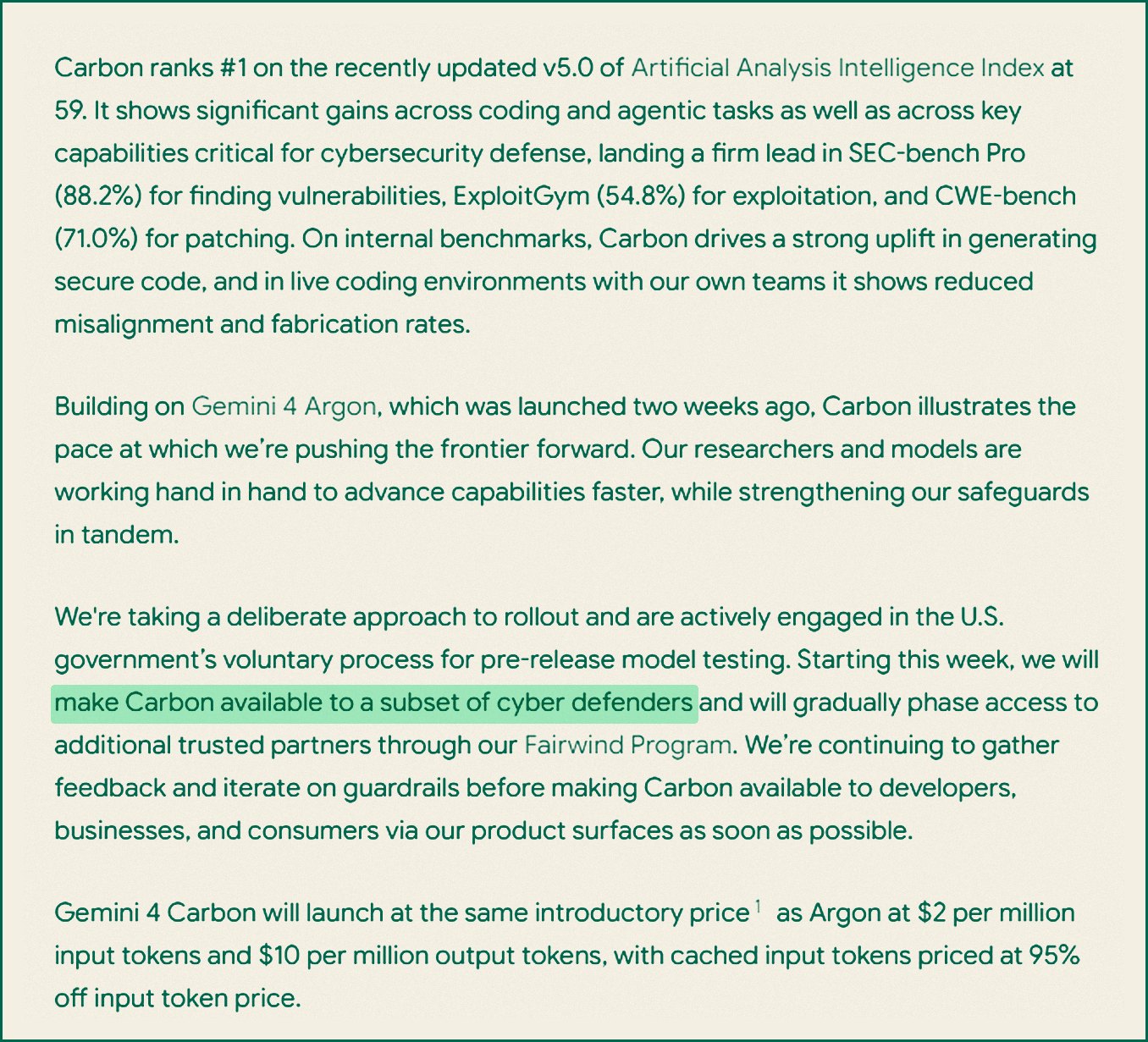
The best clue is how Google handled Argon, the first Gemini 4 model. Google announced Argon on 30 September, also through Fairwind first. It opened Argon to paying users and the paid API on 13 October, 13 days later. If Carbon follows the same path, paying users get it around 10 November. Google hasn't promised that, though. This time it is also running Carbon through the US government's voluntary testing before release, which Sundar Pichai mentioned on Alphabet's earnings call.
People on Hacker News were not happy about this pattern. One user, deanc, said he was tired of Google "talking about having released a model and then it being unavailable" to paying subscribers for months. That complaint has a point. When you announce a model with a launch post, a price, a ranking and a billion-user app behind it, people read that as a release.
Who can use Gemini 4 Carbon right now?
Right now, only the defenders Google picks can use it. Fairwind is a programme Google started on 2 September 2026 for "high-priority defenders". Its page names governments, healthcare providers and telecom companies as examples. Google says it has over 650 partners around the world, but it doesn't name them, and I couldn't find a single Indian organisation linked to it. To join, an organisation fills in a form and goes through a check of its security history. Only its internal security teams get access, and making malware is banned.
I get why a company would hold back a model that is this good at finding and using security holes. I still think Google's way of doing it needs a hard look. A private company now decides which hospitals, governments and businesses get the best defence tool in the world first. In an October research note, the Cloud Security Alliance warned that "the organizations least likely to be vetted may often be those with the fewest security resources". A small hospital in Nagpur or a city water board in Kenya is far less likely to be on Google's list than a bank in New York.
How much does Gemini 4 Carbon cost?
Google says Carbon will launch at the same introductory price as Argon: $2 per million input tokens and $10 per million output tokens, with cached input 95 percent cheaper. After the launch offer, the price becomes $4 and $20. That standard price is the same as Claude Opus 5.5, so the cheaper number in the headlines lasts only as long as Google's offer does. Argon's launch price ends on 30 November 2026, and Google has given no end date for Carbon's.
Two more things matter if you plan to use it. Argon is not on the Gemini API free tier, and nothing suggests Carbon will be. And for India, there is a catch with the free Google AI Pro plan that Jio gives its 5G users. In a Google developer forum thread from 16 to 24 October, people with the Jio plan said Argon disappeared from Google's Antigravity coding tool, and other users replied that Jio plans are treated as promotional or trial plans. No Google staff member confirmed this in the thread, but if you have AI Pro through Jio, don't assume Carbon will show up for you the day it reaches AI Pro.
Is Gemini 4 Carbon better than Claude Opus 5.5?
On most of Google's own tests, yes, but by less than the word "number one" suggests. Google's table compares Carbon with Argon, GPT-6 Astra, Claude Opus 5.5 and Claude Fable 5.1. Carbon wins 14 of the 16 tests it shares with Opus 5.5. It leads by a long way on huge documents, on office automation, and on maths and science. It loses on two tests that matter to anyone who uses AI for real work. On OSWorld, one of Google's two tests of whether a model can use a computer like a person, Opus 5.5 scores 87.2 percent and Carbon 81.5 percent, though Carbon wins the other one, Agents' Last Exam. On FrontierSWE 2, a software engineering test, GPT-6 Astra scores 65.5 percent, Opus 62.3 percent and Carbon 61.2 percent.
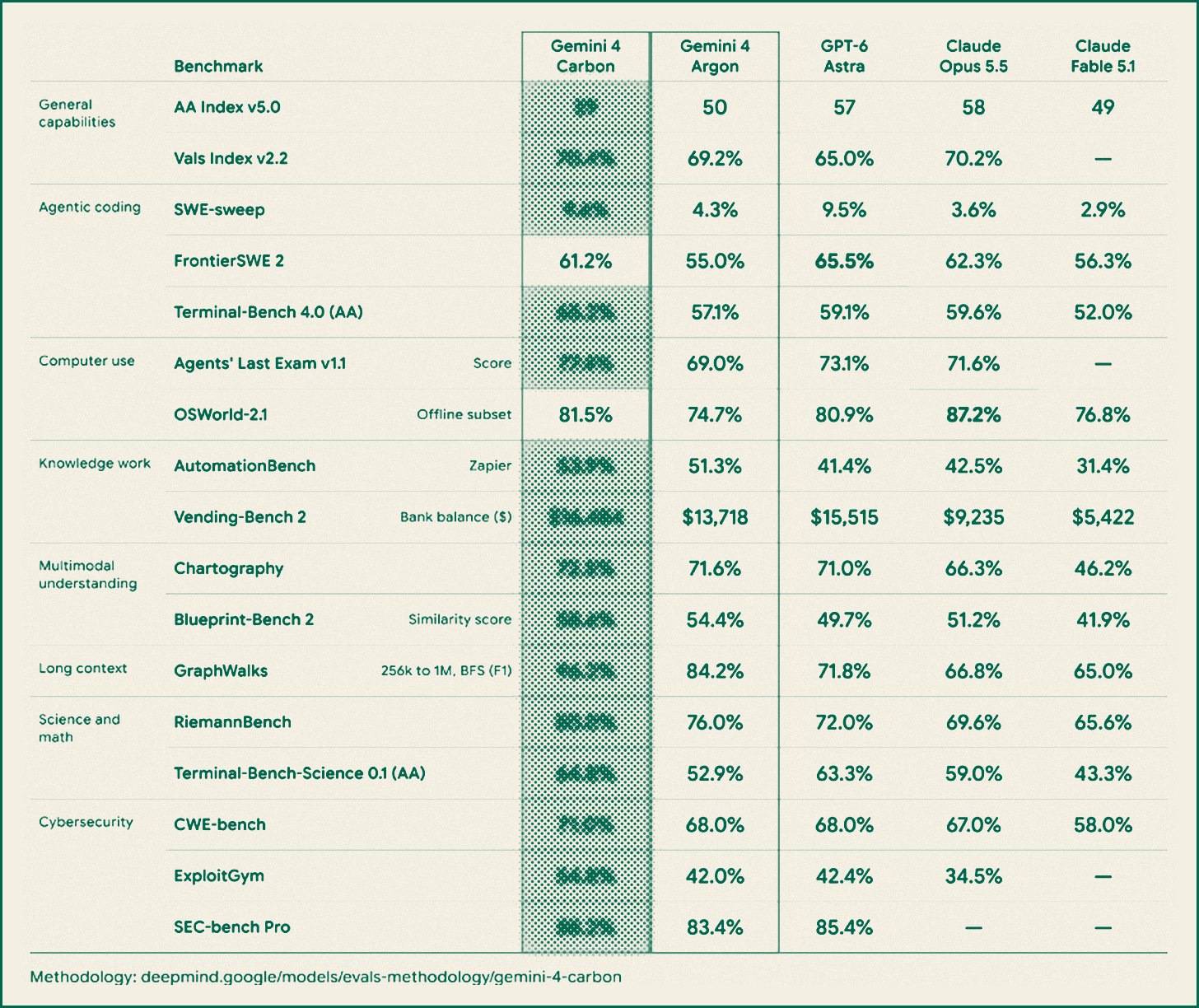
One outside ranking that Google didn't include tells a closer story. On Artificial Analysis's coding agent ranking, Opus 5.5 inside Claude Code scores 62 and Carbon scores 59. On the Vals Index, which Google's table does show, Carbon gets 70.36 percent against 70.18 percent for Opus 5.5, which is inside the test's margin of error. Claude Sonnet 5.5, the cheaper Claude model, tops that index with 70.85 percent, though all three are within the margin. Artificial Analysis tested Carbon at its "high" reasoning setting and Opus and Astra at "max", which is why "gemini 4 carbon (high)" is one of the things people search for. High is the top setting Gemini offers, so each model ran at its maximum.
Google also left out a number that cuts the other way. It says Carbon makes about half as many unsupported claims as Argon, using its own internal measure. On Artificial Analysis's public fact test, Carbon got more answers right than Argon, 58 percent against 48, and its overall score rose from 46 to 54. But its hallucination rate went up too, from 4 percent for Argon to 11 percent. That is still far lower than the 50 percent the same test gives Opus 5.5 and GPT-6 Astra, so Carbon remains one of the most careful models on that test. On making things up, though, the trend runs the other way from what Google's post implies.
Google's table has a weak spot too. For the other companies' models, Google mostly copied the scores those companies published themselves. Its methodology document says rival scores come from "self-reported numbers" unless it notes otherwise. Each lab picks its own settings, so the table puts side by side numbers that were made in different ways.
What does "a significant leap in cybersecurity" mean?
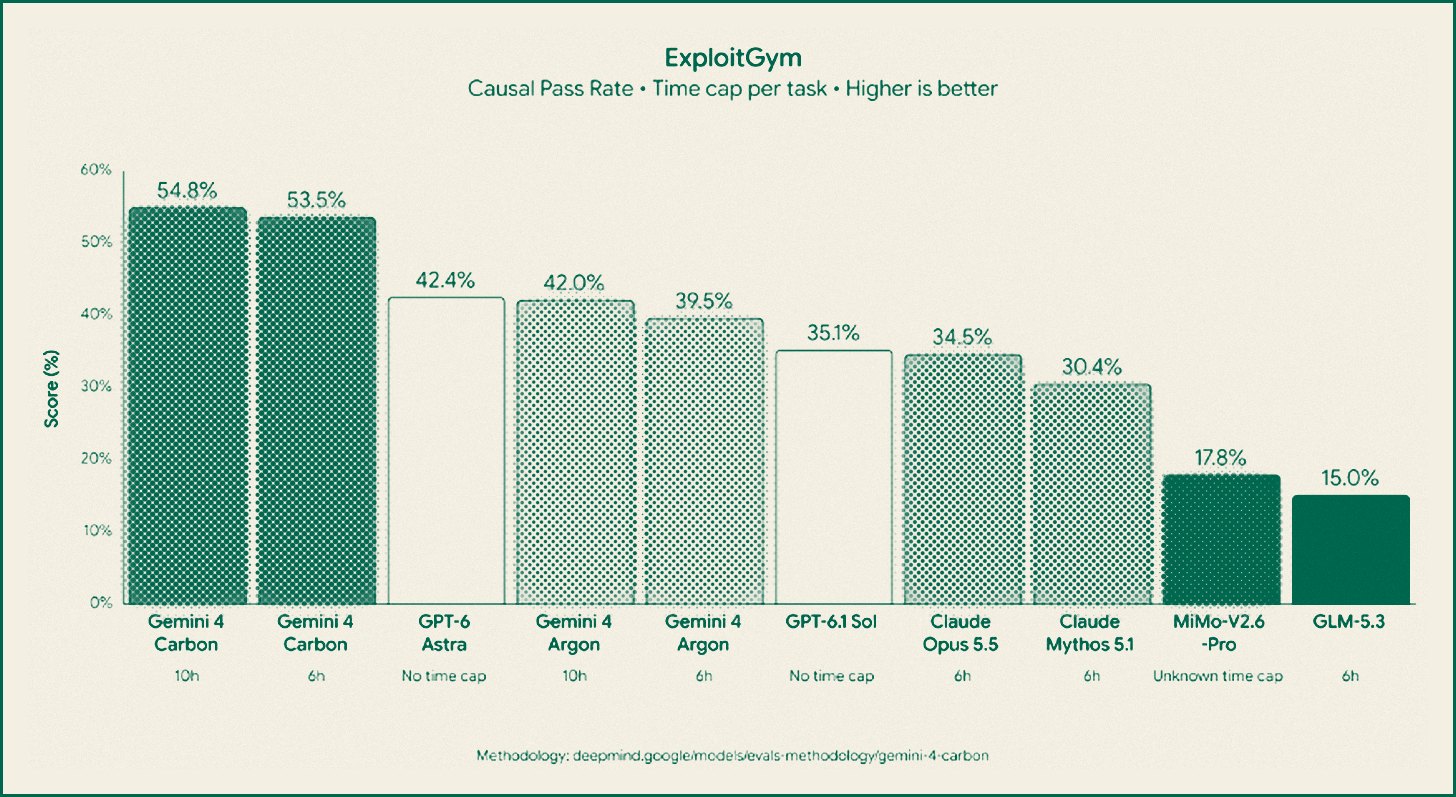
This is the part Google leads with, and it is the part I'd read most closely. Google measures cyber skill in three steps. Finding real security holes is SEC-bench Pro, where Carbon scores 88.2 percent. Proving a hole can be used to break in, which is called exploitation, is ExploitGym, where Carbon scores 54.8 percent. Fixing the hole is CWE-bench, where Carbon scores 71.0 percent. The biggest jump over Argon is in exploitation, up almost 13 points, while the jump in fixing is 3 points. So the skill that improved most is the one an attacker wants most.
The fine print matters here, and I found three details almost nobody has reported. First, the 54.8 percent on ExploitGym gave Carbon 10 hours per task, while the Claude models on the same chart were run with 6 hours. At 6 hours Carbon scores 53.5 percent, so it still comes first, but the headline number is not a like-for-like comparison. Second, the 88.2 percent on SEC-bench Pro comes from a part of the test that only uses JavaScript engines, 183 tasks in all, according to page 3 of Google's methodology document. No Claude model appears on that chart at all. Third, Google's post says the cyber tests were "evaluated without guardrails". That means the scores come from a version of Carbon without the safety blocks that the version you eventually get will have.
The bigger gap is in what Google hasn't published. Carbon has no model card. Google's model card list shows only Argon. There is also no safety report for Carbon. The safety report that does exist covers Argon, and it says something Google's launch post doesn't repeat. It states that Google "cannot rule out" that Argon, without its safety measures, reaches the cyber danger level in Google's own safety rules, and that unprotected Argon could make a serious attack about 16.7 times cheaper on average across the cases Google tested. Carbon is stronger than Argon at exactly these tasks, and Google has not told us where it lands.
"Gating it is the responsible move, and it helps defenders"
That is the best case for Google, and it deserves to be put fairly. Holding back a model that is good at breaking into systems, and giving it first to the people who defend them, buys defenders time to fix holes before attackers get the same power. The data so far is on Google's side in one way. VulnCheck counted only 14 of 1,061 security holes found by AI, about 1.3 percent, as used in real attacks during the first half of 2026. And Google's safety report says that the public version of Argon refused every step of its agent-style hacking tests, so the version regular users get is much tighter than the one in the charts.
I don't think that settles it, because finding holes was never the slow part. Fixing them is the slow part. FIRST, the global group of security response teams, expects about 66,000 new security holes to be published in 2026, and every one of them needs a person to fix it. A tool that finds holes faster, without helping the people who fix them, only makes the pile bigger. The head start also lasts only as long as the gate holds. On 29 October, one day after Carbon, Mistral put the full weights of its trillion-parameter model on Hugging Face for anyone to download, and Mistral sells that model as strong at cyber tasks too. Once an open model like that exists, a gate on Carbon protects Google's name more than it protects the internet. One Hacker News user, cotillion, was blunter than I would be. He called the setup "a racket", because open-source projects that can't get into Fairwind can't use Carbon to secure their own code.
What I want from Google
Koray Kavukcuoglu signed the launch post, and Sundar Pichai praised Carbon on the earnings call. Both ask us to accept "number one" and "a significant leap in cybersecurity". Neither has shared the document that would let anyone check the second claim. Google published a safety report for Argon. It should publish one for Carbon before it opens Carbon to the public, and that report should say plainly whether Carbon crossed the cyber danger level that Google could not rule out for Argon. Anthropic's Mythos and OpenAI's GPT-6 Astra were also held back for cyber reasons, so the industry already knows how to explain these decisions. The difference with Carbon is that Google is selling the strength now and saving the risk report for later.
My prediction
Google will open Carbon to paying Gemini users and to the Gemini API before 30 November 2026, the day Argon's launch price ends, and it will not be on the free tier. If either part of that turns out wrong, I will say so here.
I'm betting on this for three reasons. Argon went from announcement to paying users in 13 days. Google already has a price for Carbon. And a model that ranks first is worth more to Google in the Gemini app than in a closed programme for 650 partners. Watch the Gemini API changelog, not the next launch post, because the changelog is where a model becomes real.
Questions people are asking
What is the Gemini 4 Carbon release date? Google announced it on 28 October 2026 but hasn't released it to the public. It goes first to cyber defenders and Fairwind partners, then to developers, businesses and the Gemini app "as soon as possible", with no date given.
How much will Gemini 4 Carbon cost? $2 per million input tokens and $10 per million output tokens as a launch offer, with cached input 95 percent cheaper. After that, $4 and $20, the same as Claude Opus 5.5.
Is Gemini 4 Carbon better than Opus 5.5? It wins most of Google's own tests and leads the Artificial Analysis Intelligence Index by one point. Opus 5.5 wins on OSWorld, one of the two computer-use tests, and scores higher on Artificial Analysis's coding agent ranking.
What is Gemini 4 Argon? Argon is the first Gemini 4 model. Since 13 October 2026 it has been on the paid Gemini API and in the Gemini app for Google AI Pro and Ultra subscribers. Carbon is the stronger model that came next.
Can I use Gemini 4 Carbon in India? Not yet. Google has published no date for India, and Indian developers will pay the same dollar price as everyone else. Some users on the free Jio AI Pro plan reported losing Argon in Antigravity, so check your plan before you count on Carbon.
Why is Gemini 4 Carbon only for cyber defenders? Google says Carbon is strong at finding, testing and fixing security holes, and it wants defenders to have it first. Its safety report for Argon, the earlier model, says Google could not rule out that Argon without safeguards reaches its cyber danger level.
Sources
- Google, 'Gemini 4 Carbon: our next frontier model' (The Keyword), Koray Kavukcuoglu, 28 Oct 2026:blog.google/innovation-and-ai/…
- Google DeepMind, Gemini models page with the full benchmark table:deepmind.google/models/…
- Google DeepMind, Gemini 4 Carbon evaluation methodology (PDF, 4 pages):storage.googleapis.com/deepmind-media/…
- Google DeepMind, Gemini 4 safety report (covers Gemini 4 Argon), Oct 2026:storage.googleapis.com/deepmind-media/…
- Google DeepMind, model card index (only Gemini 4 Argon listed):deepmind.google/models/…
- Google DeepMind, Fairwind Program:deepmind.google/fairwind-program
- Google, 'Proactive cyber defense for governments and enterprises', Four Flynn, 2 Sep 2026:blog.google/innovation-and-ai/…
- Google on X, Gemini 4 Carbon launch post, 28 Oct 2026:x.com/Google/…
- Google AI on X, 'a subset of trusted cyber defenders', 28 Oct 2026:x.com/GoogleAI/…
- Sundar Pichai, Alphabet Q3 2026 earnings call, 28 Oct 2026 (transcript, The Motley Fool):fool.com/earnings/…
- Gemini API pricing page:ai.google.dev/gemini-api/…
- Gemini API changelog:ai.google.dev/gemini-api/…
- Artificial Analysis, 'Gemini 4 Carbon is the new number 1', 28 Oct 2026:artificialanalysis.ai/articles/…
- Artificial Analysis, Gemini 4 Carbon model page:artificialanalysis.ai/models/…
- Vals.ai, Gemini 4 Carbon results:vals.ai/models/…
- VentureBeat, Google unveils Gemini 4 Carbon, 28 Oct 2026:venturebeat.com/technology/…
- Cloud Security Alliance, research note on trusted defender access, 3 Oct 2026 (PDF):labs.cloudsecurityalliance.org/wp-content/…
- Infosecurity Magazine, one percent of AI-found vulnerabilities exploited (VulnCheck), 29 Jul 2026:infosecurity-magazine.com/news/…
- Help Net Security, FIRST 2026 CVE forecast, 15 Jun 2026:helpnetsecurity.com/2026/…
- TechCrunch, Mistral releases weights for its trillion-parameter model, 29 Oct 2026:techcrunch.com/2026/…
- Hacker News discussion of the launch, 28 Oct 2026:news.ycombinator.com/item
- Hacker News comment by cotillion, 28 Oct 2026:news.ycombinator.com/item
- Hacker News comment by deanc, 28 Oct 2026:news.ycombinator.com/item
- Google AI developer forum, Gemini 4 Argon missing from Antigravity (Jio AI Pro users), 16 to 24 Oct 2026:discuss.ai.google.dev/t/…
- Google India, partnership with Reliance Jio for Google AI Pro, 30 Oct 2025:blog.google/intl/…
- Anthropic, Project Glasswing:anthropic.com/glasswing
- Let's Data Science, OpenAI releases GPT-6 Astra with cyber safeguards:letsdatascience.com/news/…
- Claude API pricing (Claude Opus 5.5 at $4 and $20 per million tokens):platform.claude.com/docs/…