
Google Genie 4 is the new world model from Google DeepMind, announced on 27 October 2026. It builds a scene that looks like real video, and you walk through it with your keyboard and change it by typing. For the first time in a Genie model, the world makes its own sound and the people in it talk back. You can't use it yet, because it is a test version for a small group of trusted testers. Google says it is "coming soon" to people who pay for Google AI Ultra. That plan starts at $99.99 a month in the US and ₹6,500 a month in India. And Google's own page says a Genie 4 world holds together for "a few minutes," which is the same phrase it used for Genie 3 fourteen months ago.
I read the DeepMind blog, the Genie model page, and the older Genie 3 and Genie 2 pages to compare them. I also read Google's help page for Project Genie and the threads on Hacker News, Ars Technica and X where people picked the demos apart. The launch video is the most impressive thing Google has shown in this area. The fine print around it tells a quieter story, and I think that story is more useful to you.
What Genie 4 actually is, in plain words
A normal AI video tool makes a clip, and you sit and watch it. A world model works in a different way, because it draws the next moment of the scene while you move through it. When you press the arrow key, the street turns in front of you, and when you type "make it rain," the rain starts and the people react to it. None of this is made in advance, since every frame is created on the spot.
Genie 4 adds three big things on top of Genie 3. The first is how it looks, and Google says "Gemini Omni anchors the simulations in real-world appearance and behavior." That is why the launch clips look like phone footage and not like a video game. The second is a kind of director that runs in the background. DeepMind says Gemini 3.8 Flash "continuously observes the scene, breaks down goals into a sequence of steps, and reviews incoming frames" to check that each step worked. The third is sound, and DeepMind calls Genie 4 "our first real-time world model to generate audio natively." You hear wind in the trees and crashing waves, and DeepMind is proudest of this line: "interactive dialogue that adapts on the fly."
So when someone on X joked "GTA6 generated in realtime before GTA6," the joke worked because the clips really do look that good. The real question is how long they stay that good, and on that question Google's own words matter more than its trailer.
The "two minutes" number that isn't on Google's pages
Almost every news story today says a Genie 4 world lasts about two minutes, which would be double the one minute of Genie 3. The Verge wrote "about two minutes long, up from one minute for the previous Genie 3 model." TechCrunch wrote "up to two minutes, double its predecessor's limit." Neither of those numbers appears anywhere on Google's own pages.
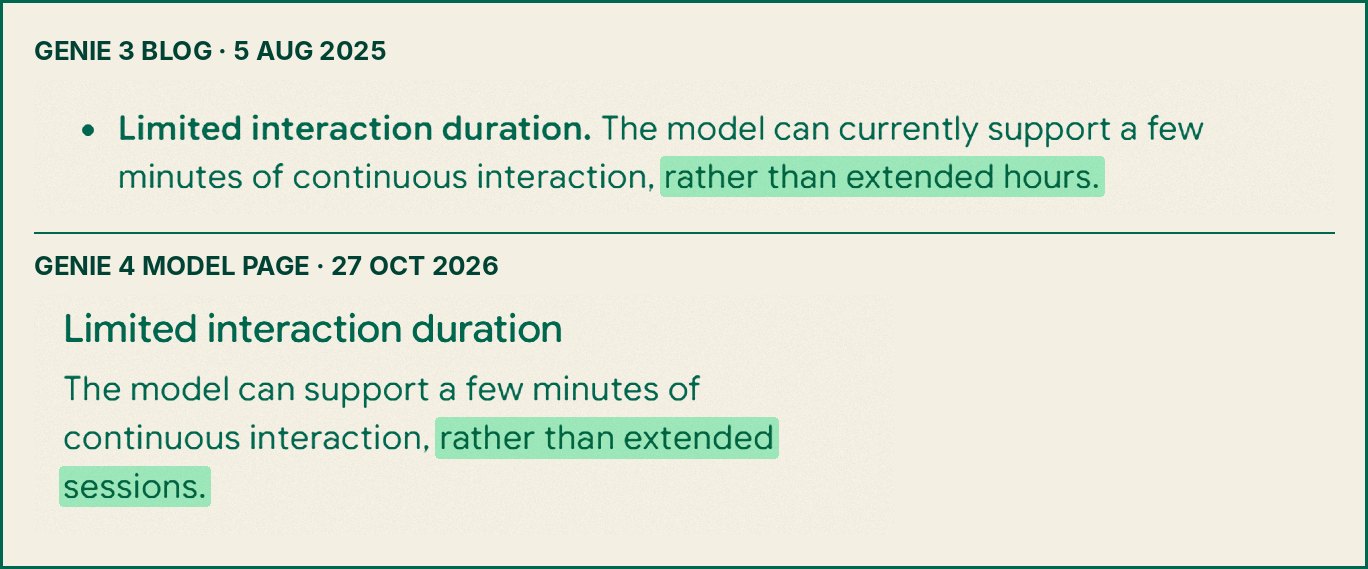
What Google actually wrote on the Genie 4 model page is this: "The model can support a few minutes of continuous interaction, rather than extended sessions." Now compare it with what Google wrote for Genie 3 in August 2025: "The model can currently support a few minutes of continuous interaction, rather than extended hours." In fourteen months, Google dropped the word "currently" and changed "extended hours" to "extended sessions," and that is the whole change.
So where did the "one minute" come from? Genie 3's own blog promised "a few minutes," not one minute. The one-minute limit people actually ran into was the timer inside Project Genie, the app Google opened to paying users in January 2026. Google's help page for that app says, "You have 60 seconds to explore the generated world." Shlomi Fruchter, a research director at DeepMind, explained that limit to TechCrunch at the time. "The reason we limit it to 60 seconds is because we wanted to bring it to more users," he said. "Basically when you're using it, there's a chip somewhere that's only yours and it's being dedicated to your session."
Read that quote again and think about Genie 4. The limit people felt was a business choice about how many chips Google would give each user. So when the news says the time has doubled, it is comparing an app timer with a claim about the model. My own read is that the real limit on Genie is the cost of each user, and not the science. Genie 4 also runs Gemini models alongside it, watching and steering the scene while it is drawn, and that adds work to every session instead of taking it away. Ars Technica put the price question plainly when it wrote, "It won't be cheap."
No spec sheet, and a demo with a physics mistake
When Google launched Genie 3, it told us the picture quality and the speed, which were 720p at 24 frames per second. For Genie 4, Google has shared no resolution, no frame rate, no delay figures, no training data, no model card and no price. I searched the blog and the model page for each of these, and none of them are there.
Compare that with Runway, a much smaller company that launched its GWM Worlds 2 model in September. Runway published "continuous 720p video at 24 fps and audio at 48,000 Hz," and it said its sessions "have no preset length." You can argue about whose model is better, but you can't argue about which company told you more.
At the very bottom of the Genie 4 model page, in small grey text, Google adds this line: "Results for illustrative purposes. Sequences shortened." The demo prompts on that page run to hundreds of words, and they are full of orders like "no CGI appearance, no video game look." A Hacker News user named wolttam summed up the feeling: "Real nice prompting there, Google. It also still looks like a video game rendering."
The physics claim has a problem as well. Google says Genie 4 "simulates real-world physics scenarios, such as aerodynamics, collisions, and more." One of its showcase clips drops a marble bust onto a watermelon, and two people on two different sites spotted the same mistake. On Hacker News, mlmonkey wrote that "the bust should've toppled over, if the physics were properly modeled." On the Ars Technica forum, LongTimeLurker629 wrote that "it's leaning past its gravity center, how does it go straight back like it's a roly-poly toy." Physics is the main thing Google is selling here, so when normal viewers can spot a physics error in a hand-picked clip, that clip is telling you something.
People said the same thing about the last version too. When Project Genie launched in January, a Hacker News user named bdbdbdb said much the same thing. The comment read: "It's very impressive tech but subject to the same limitations as other generative AI: Inconsistency, inaccurate physics, limited time, lag, massively expensive computation." Another user, jsheard, asked, "Isn't this still essentially 'vibe simulation' inferred from videos?" Nine months later, the marble bust shows the physics worry still holds, and Google's own wording shows the time limit hasn't really moved either.
There is some history here that matters too. When DeepMind showed Genie 2 in December 2024, its blog admitted that the clips came from "an undistilled base model." It also said the version you could play live ran "with a reduction in quality of the outputs." I am not saying Genie 4 does the same thing, because Google hasn't said either way. I am saying Google has done it before, and a proper spec sheet would settle the question.
So my callout goes straight to Google DeepMind. You are taking Genie 4 to paying Ultra users and to business partners, and you are showing it to newsrooms and film studios. Please publish the resolution, the frame rate, the real session length in Project Genie and what the model learned from. Runway shares these numbers, and you shared them for Genie 3, so there is no good reason to stop now.
Where Genie 4 is genuinely good
I don't want this piece to read as if Genie 4 is a trick, because it isn't one. Some of what Google showed is useful to real people right now.
The best use is the one DeepMind leads with, which is planning a film scene before shooting it. Testers in film use Genie 4 as a "draft mode," where a director steps into a rough version of a scene and runs several "takes." They can change the light, the camera angle and the lines while the scene plays. Small teams usually can't afford this step at all. On the Ars Technica forum, multimediavt made the fair case: "Some folks can't afford to pay for practical or digital special effects for their low-budget productions." For people like that, a rough moving sketch of a scene, with sound, made in seconds, is a real gift.
Game designers get a similar win. DeepMind says testers go "from an initial idea to an explorable prototype in seconds ... before writing a single line of engine code." That is a quick way to learn that a game idea is boring before you spend six months building it.
Robots are the third use, and it is the one Google cares about most. The blog shows Genie 4 and Google's newest model, Gemini 4 Argon, running a pretend Apptronik Apollo robot that plays checkers. The model page calls this "an infinite playground for robotics simulations." Back in January, a Hacker News user named in-silico explained the idea simply. "The goal of world models like Genie is to be a way for AI and robots to 'imagine' things," the user wrote. This week on X, @AIRoboticsInt put the business side bluntly: "Whoever owns the simulator owns robot training."
The sound is a real step forward for Google as well. It is not a first for the whole industry, because Runway released a test version of a world model with live sound in September. But it is the first time a Genie world sounds like a real place. Built-in sound turns a silent clip into something an AI can listen to, and that matters for training AI, not just for showing off.
The part that worries me: real photos, fake history, and people who talk
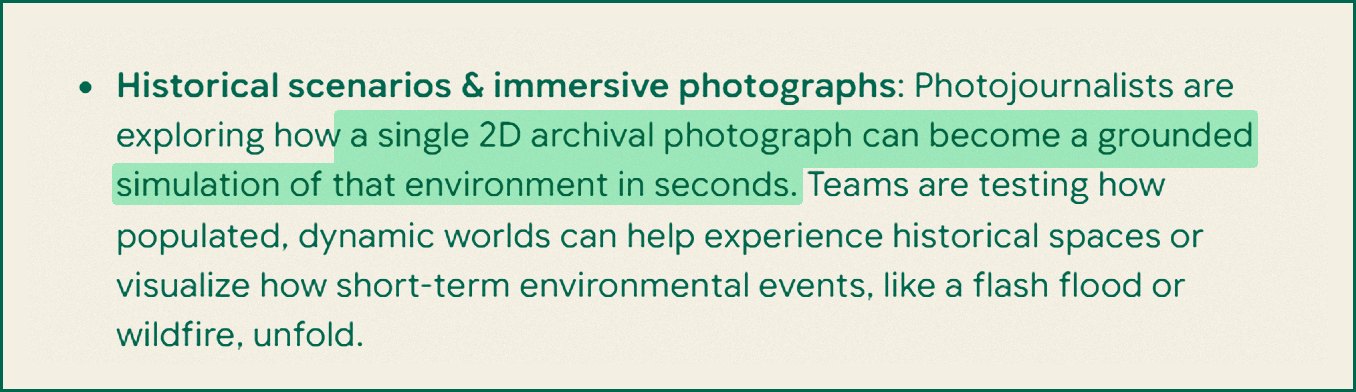
One line in the DeepMind blog keeps pulling me back. In its list of tester projects, Google writes: "Photojournalists are exploring how a single 2D archival photograph can become a grounded simulation of that environment in seconds."
Now put that next to a line from Google's own list of limits: "Genie 4 is currently unable to simulate real-world locations with perfect accuracy." Then add people who look real, move naturally and speak in real time. What you get is a tool that can take an old photo of a real place on a real day. It can then turn that photo into a scene you can walk through and hear. Parts of that scene are made up, and it happens "in seconds." A historian using this with care is one thing. A random account posting "rare footage" of a famous event is something else, and nothing in the product stops the second case.
Google's answer is SynthID, an invisible watermark, and the blog says "all video and audio generated by Genie 4 will include SynthID." That helps, but only when someone actually runs a checker on the clip. Nobody runs a checker on a video forwarded in a family WhatsApp group. When Google announced Gemini Omni in May, it said users making a digital avatar would first have to record themselves "speaking out a series of numbers," to stop deepfakes. I could not find anything like that for the people inside Genie 4 worlds. On the Ars forum, 42Kodiak42 went further than I would. Still, the start of that comment is hard to ignore: "There are two profitable use cases for this: Deepfake-powered scams, particularly useful for spearphishing."
This worry about real places is not just a theory for Google. Around Google I/O in May, Semafor reported that Demis Hassabis said Google Maps now uses the Genie world model to improve Street View. So Genie already shapes how real places look inside a product that billions of people trust as a record. That is a reason for Google to be stricter with Genie 4, not looser.
A Hacker News user named zardo also spotted a smaller problem in the launch video. "Showing off an anglo-bias with the Japanese train station in the 1980s, with a man speaking english," zardo wrote. It is a small thing in a demo, but it becomes a big thing when the same model is offered for history and education.
"It's only a research preview, so stop judging it like a product"
This is the strongest pushback to everything above, and I have seen it in every thread. Genie 4 is early, and Google itself says it is "an early, evolving area of research." So why should we hold it to product rules, like a spec sheet and strong safety checks?
The answer is that Google itself is treating Genie 4 like a product. It is giving access through Google AI Ultra, a paid plan that starts at $99.99 a month in the US. It is giving it to "early access partners of the Gemini API," which means businesses that will build on it. It already has testers in five named fields: "creative industries, journalism, education, gaming, and engineering." The stock market treats it like a product too. When Project Genie launched in January, Unity's share price fell around 20 to 24 percent in a day, depending on which report you read, and Roblox fell about 13 percent. Bloomberg's headline on Genie 4 today calls it the "AI World Model That Rattled Video Game Stocks."
Once money changes hands and newsrooms are invited in, "it's just research" stops being a good defence. A research paper tells you the numbers, and a product tells you the price. Right now Genie 4 does neither, and that is the part I am criticising, not the science behind it.
Who should care about Genie 4 right now
If you are a regular user, the honest answer is not yet. You can join the waitlist, but the first wave goes to Ultra subscribers, and Project Genie is already limited to Ultra users who are 18 or older. Two replies under DeepMind's launch post said what many people were thinking, and both were fair. "Wake me up, when i can use this under $100," wrote @sarwangsinha, and @KCCrypto369 added, "it's testers only AGAIN."
If you are in India, Google AI Ultra costs ₹6,500 a month for the lower tier and ₹19,500 a month for the higher one. Google's India plans page already lists Project Genie as an Ultra benefit. But Google has not said whether India gets Genie 4 in the first wave, so don't pay for Ultra just for this until Google says so.
There is a bigger question for India as well. In the Union Budget 2026-27, in the same week Project Genie shook game stocks, India announced animation and gaming labs in 15,000 schools and 500 colleges. The government has also said the country will need 2 million workers in animation, VFX, gaming and comics by 2030. Genie 4 is built to speed up the first steps of exactly those jobs, like planning scenes, drawing early concepts and making quick game demos. Are we training students for jobs that a world model is being built to shrink, or for the jobs of directing that model? Nobody in Indian education policy has answered this out loud yet, and they should.
If you make games, think of Genie 4 as a sketchbook and not a studio. A Google spokesperson told The Register in January that Genie "is not a game engine and can't create a full game experience." On Hacker News, pdntspa asked the obvious question: "does this export 3d assets or an Unreal/godot/unity project." Everything Google has published says the answer is no, because it gives you pixels and sound, not files you can ship. Back in January, nsilvestri made the point every game maker already knows: "The bottleneck for games of any size is always whether they are good."
My prediction
By 31 March 2027, Google will still not have published Genie 4's resolution, frame rate or training data sources. That covers its Genie model page, its blog and any technical report. If Google publishes any one of those three, I was wrong, and I will say so here.
I am betting on this for three reasons. Google shared no training data for Genie 2 or Genie 3 either, and it is already under copyright pressure after Disney's cease-and-desist letter in December 2025. On top of that, Google has now dropped the resolution and frame rate numbers it was happy to share for Genie 3. So watch the Project Genie help page, not the trailer, because when Google is confident about a number, it puts it there.
Questions people are asking
What is Google Genie 4? It is Google DeepMind's newest world model, announced on 27 October 2026. It creates a scene that looks like real video, with sound and characters who speak, and you control it with your keyboard and typed prompts.
When is the Genie 4 release date? There is no public date yet. It is a test version for trusted testers right now, and Google says it is "coming soon" to Google AI Ultra users in Project Genie and to early business partners. TechCrunch reported "in the coming weeks."
How do I try Genie 4? Join the Project Genie waitlist, which is linked from the DeepMind blog. You will need a Google AI Ultra plan, because Project Genie is only for Ultra users who are 18 or older.
How long does a Genie 4 world last? Google says "a few minutes of continuous interaction." News reports say about two minutes. Google also warns that small details and objects start to drift the longer a session runs.
Is Genie 4 better than Genie 3? It looks far more real, it adds its own sound and talking characters, and it uses Gemini as a director. On how long a world lasts, though, Google's own wording has barely changed since Genie 3.
Can Genie 4 videos be detected as AI? Google says every Genie 4 video and sound clip carries SynthID, its invisible watermark. You need a SynthID checker to find it, so a clip that nobody checks looks like normal footage.
Sources
- Google DeepMind, 'Genie 4: A new generation of world simulation', 27 Oct 2026:deepmind.google/blog/…
- Google DeepMind, Genie model page (limitations and disclaimer):deepmind.google/models/…
- Google, 'Introducing Genie 4' (The Keyword), 27 Oct 2026:blog.google/innovation-and-ai/…
- Google DeepMind, 'Genie 3: A new frontier for world models', 5 Aug 2025:deepmind.google/blog/…
- Google DeepMind, 'Genie 2', Dec 2024:deepmind.google/blog/…
- Google Labs help, Project Genie:support.google.com/labs/…
- Google AI plans (US):one.google.com/intl/…
- Google AI plans (India):gemini.google/in/…
- The Verge, Genie 4, 27 Oct 2026:theverge.com/tech/…
- TechCrunch, Genie 4, 27 Oct 2026:techcrunch.com/2026/…
- Ars Technica, Genie 4, 27 Oct 2026:arstechnica.com/google/…
- TechCrunch, Project Genie hands-on (Shlomi Fruchter quote), 29 Jan 2026:techcrunch.com/2026/…
- The Register, Project Genie, 29 Jan 2026:theregister.com/2026/…
- TechCrunch, Gemini Omni launch, 19 May 2026:techcrunch.com/2026/…
- Semafor, Demis Hassabis at Google I/O, 20 May 2026:semafor.com/article/…
- Bloomberg, 'Google Upgrades AI World Model That Rattled Video Game Stocks', 27 Oct 2026:bloomberg.com/news/…
- TechCrunch, Disney cease-and-desist to Google, 11 Dec 2025:techcrunch.com/2025/…
- Runway, GWM Worlds 2, 3 Sep 2026:runway.com/research/…
- Tom's Hardware, game stocks after Project Genie, Jan 2026:tomshardware.com/video-games/…
- Pixel P&L, India AVGC labs in Budget 2026-27:pixelpnl.beehiiv.com/p/…
- Hacker News discussion, 'Genie 4':news.ycombinator.com/item
- Hacker News discussion, 'Project Genie', Jan 2026 (bdbdbdb, jsheard, in-silico, nsilvestri):news.ycombinator.com/item
- Ars Technica forum discussion:arstechnica.com/civis/…
- Google DeepMind on X, Genie 4 announcement:x.com/GoogleDeepMind/…