

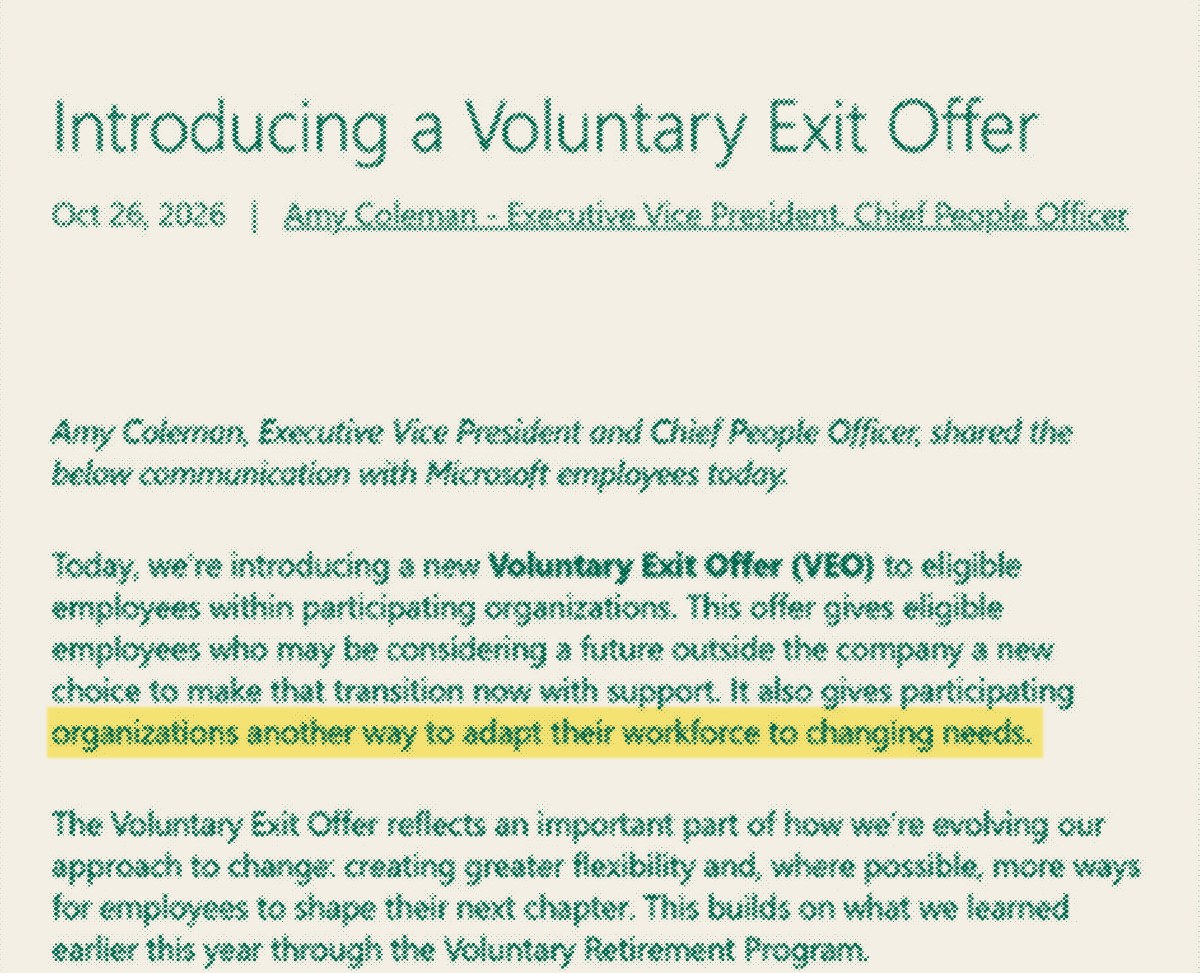
Microsoft sent a Voluntary Exit Offer to about 60,000 of its 223,000 employees on October 26, across the US, UK, Canada and India. The money on the table is Microsoft's standard severance, nothing more, with a cap of 39 weeks of pay. Microsoft itself told The Register it "isn't a buyout because no one is being incentivized to leave." So the only thing you actually get for signing early is certainty, and the question every employee is now asking on Blind is whether certainty is worth anything when the next layoff pays the same.
I spent the morning reading the company memo, the coverage, and the threads where Microsoft employees are talking to each other about it. The story in the news is "Microsoft offers buyouts." The story inside the company is very different, and it is the one worth your time.
What the offer actually pays
The press called it a buyout, so people assumed a sweetener. There isn't one. The formula, reported by Business Insider and confirmed by a Microsoft employee on Blind, is this. If you are at Senior level or below, you get one week of base pay for every six months you worked. Principal and above get two weeks per six months. The floor is eight weeks, the ceiling is 39 weeks. You get six months of subsidised health cover and your stock keeps vesting for six or twelve months depending on how long you have been there. That is it.
In India, the press reports said one month of base salary for every completed year of service. The people who actually got the email say there is more to it. Harveen Singh Chadha, in a post on X that has been seen 821,000 times, wrote: "Microsoft India sends VEO to employees in level 70 and below in most of the orgs. One month of base pay per year in microsoft + 3 months pay. Decision to be made in a month." Divya Porwal, in a separate post seen 224,000 times, reported the same formula from a friend inside: "1 month of base salary for every year spent at Microsoft + 3 months of salary. Employees have a month to decide." So the India offer is one month per year plus a flat three months on top, with a December 1 deadline. Microsoft India has around 23,000 staff and the company has not said how many got the email. One Indian employee on Blind pointed out that stock is not mentioned anywhere in the India offer, and nobody from the company has cleared that up.
That three-month floor matters. A three-year engineer in Hyderabad gets six months of pay. A three-year engineer in Redmond at Senior level gets six weeks. For once, the India package is the better one, and that is the detail every Indian reader is searching for right now: Google Trends shows India as the second biggest region in the world for "microsoft layoffs" searches in the last 24 hours.
Do the maths for a normal person. Five years at Microsoft as a Senior engineer gets you a bit over two months of pay. An Amazon employee on Blind put it plainly: "If I worked at a company for 5 years I get a little over 2 months pay... This is horrible for anyone not at Microsoft for 15+ years." That comment has 53 upvotes, and nobody argued with it.
Compare that to the retirement offer Microsoft ran in spring, which came with extended healthcare and went to around 8,750 older US staff. About 30 percent of them took it, which cost the company roughly $900 million. This time the extended healthcare is gone, the cash is capped, and Microsoft is openly telling reporters it expects uptake more like the "3 to 5 percent" other companies see. That number matters, and I will come back to it.
The thing nobody in the news is saying
A buyout with no sweetener is a strange animal. Why would anyone take standard severance in December when, if layoffs come in the new year, they get the same severance plus two more months of salary and stock? An Amazon employee asked exactly that on Blind: "should i take this up? Or should i wait two more months to get laidoff and thus get two months of additional salary/rsu?"
There are two answers floating around inside Microsoft, and they contradict each other. The Hacker News crowd, which is older and has been through more of these, says take it. "In this sort of situation, always take the first offer. Subsequent offers are always worse," wrote one user. Another: "When they offer a package YOU ALWAYS TAKE IT. It means that layoffs are coming."
The Blind crowd, which is mostly current big tech employees, says the opposite. "Buyout is just standard severance package which you would anyway get if layoffs happens," one Microsoft employee wrote. Their logic is that you lose nothing by waiting, so you wait and interview on company time.
Both groups are missing the third option, which is the one that scares people. A Microsoft employee with 17 upvotes wrote: "If you don't take the buyout, the next cycle you will magically get a 'bad' review and be terminated." That is the real fear, and it is why this offer works even without a sweetener. It is not a carrot. It is a reminder that a stick exists.
Microsoft's own words support that reading more than they deny it. In the internal HR note, the company says it "may consider" another voluntary exit offer "where there is a business and workforce need," and it told The Register that layoffs "remain part of its approach." And the recent history is clear. Spring retirement offer, then 4,800 layoffs in July, then more in September, then this in October, and Fortune reports Xbox has three more rounds planned for October, November and January. One Hacker News user summed it up: "Even with these buyouts, there will be layoffs next summer."
Who actually leaves when you do this
I went looking for research on who takes these offers, because the usual claim is that the best people walk first. The evidence is mixed, and that is worth being honest about. A Cornell study published through NBER looked at a university early retirement program and found "no evidence that on average the 'most productive' employees took the incentive." It was the lower paid staff who left. But HR researchers who study corporate buyouts say the opposite, that star performers leave because "your star performers have highly marketable skills."
The true line, which cuts both ways, is that the people who leave are the people who can get another job. In this market, that is not the strongest engineers in general. It is the people without visa problems, without kids in school, and with savings. Which brings me to the part of this story that only the forums are talking about.
The H-1B angle, and why the India office matters
A large chunk of Microsoft's engineers are on H-1B visas. If they take this offer, they have 60 days to find a new sponsor or leave the country. So they will not take it. "The h1bs will never take the offer," one Blind user wrote, and nobody disagreed. A Meta employee added a sharper point: "It is not layoff so they can still hire H1B and file perm." A layoff would complicate Microsoft's immigration filings. A voluntary program does not.
One fact makes that theory more interesting, and it was the first thing a lot of people on X connected. Ari Hoffman's post, seen 201,000 times, put the two side by side: the buyout announcement and the reminder that earlier this month the Trump administration suspended Microsoft from the green card process. On October 8, the US Department of Labor suspended Microsoft from the PERM green card process, citing "multiple active federal investigations." So Microsoft's green card pipeline is frozen regardless. I am not going to claim the two are connected, because I cannot prove it, but if you are an H-1B employee at Microsoft right now you are in the worst seat in the building. You cannot take the offer, your green card process is stuck, and your citizen colleagues are being nudged out the door around you.
The India angle kills one popular theory. A lot of people assumed this was a move to shift jobs from the US to cheaper offices. Except India got the same email, and on Indian X the story landed as a layoff, full stop. Muthukrishnan Dhandapani's post, seen 258,000 times and liked 4,800 times, opened with "Microsoft is laying off 60,000 employees, 27% of its workforce across the world. This includes India as well." That is not what Microsoft said. It is what everyone heard. "That was my thought too but they're doing it in India too," a Microsoft employee wrote on Blind. So this is not offshoring. This is a headcount cut everywhere at once, and Indian staff got a worse deal than the US one because there is no stock clause in it. An r/indianrealestate thread is already predicting a correction in mid-range apartments in tech cities, which tells you how many people over here are reading this as bad news for their own jobs.
The 3 to 5 percent number is doing a lot of work
Microsoft told Fortune it expects the uptake other companies see, around 3 to 5 percent. On 60,000 people, that is 1,800 to 3,000 leavers. That is tiny. It does not move the needle on a $145 billion capital spending year. So why run it at all?
A Block employee on Blind offered the only explanation that makes sense of all the facts: "They probably planned like 10K. If 15K take the buyout they hire 5K. If 5K take the buyout, they RIF another 5K." In other words, there is a target number, the voluntary round is the first pass, and the involuntary round fills the gap. That is exactly what happened at Intel in 2024, where voluntary separations got the company "more than halfway" to its target and involuntary notices went out a month later. It is what happened in the US federal government in 2025, where the deferred resignation program got about 2 percent uptake and more than half of the total job losses that followed were not voluntary at all.
Read Microsoft's memo again with that in mind. "The Voluntary Exit Offer is new for us. We'll learn from it." The company is not learning whether people want to leave. It is learning how many will leave on their own before it has to do the rest.
Why this is about AI even though Microsoft says it isn't
Microsoft's official position is that this has nothing to do with AI and is not a sign it needs fewer people. Take that at face value and the numbers still tell the story. Microsoft spent $145 billion on capital expenditure in its last fiscal year, guided to over $50 billion for the quarter that just ended, and says the next fiscal year will be higher again. Its operating expense guidance is mid to high single digit growth. Headcount is already down 2 percent year on year. You cannot grow capital spending by tens of billions while holding operating cost nearly flat unless something else gives, and the something else is salaries.
Nadella said it himself on a podcast last November, that Microsoft will grow headcount again but "that headcount we grow will grow with a lot more leverage than the headcount we had pre-AI." That is a polite way of saying each remaining person will be expected to do more, with AI tools, than two people did before.
An Apple employee asked the question on Blind that I think is the right one: "Real question is what does Microsoft know that we don't? Are we going to need substantially less engineers after 6 months?" Microsoft is not going to answer that in a memo. But the company that makes Copilot just told a quarter of its workforce, including the Copilot team, that it is fine if they leave. That is the answer.
What I would actually do
If you are at Microsoft and you got the email, the decision is not about the money, because the money is the same either way. It is about two things. First, are you on a visa? If yes, stay, and start lining up a new sponsor quietly, because the next round will not ask your permission. Second, do you believe your manager would protect you in a forced round? If you have any doubt, the eight weeks of certainty is worth more than two months of extra pay you are not sure you will get.
If you are not at Microsoft, this is still your story. The playbook is now public and it is cheap. Offer standard severance, call it voluntary, see who flinches, cut the rest. Every big company watching this will copy it, because it gets the same result as a layoff with a better headline and cleaner immigration paperwork. The question for you is simple. If your company sent this email tomorrow, would you know your answer? Most people on these threads did not, and the fear in their posts came from that, not from the offer itself.
My prediction, so you can hold me to it. Fewer than 3,000 people take this. Microsoft announces involuntary cuts in the first quarter of 2027 that are larger than the voluntary number. And at least two other companies with more than 100,000 employees run the exact same play before the end of March.
Questions people are asking
Is Microsoft's voluntary exit offer the same as a layoff? Financially, yes. The package is standard severance. Legally, no, which is why Microsoft keeps saying "voluntary." The difference matters most for immigration filings and for the company's public numbers.
Should I take the Microsoft VEO or wait to be laid off? If you wait and are laid off, you get the same severance plus the extra months of pay. If you wait and are instead managed out on performance, you get nothing. Nobody outside your own management chain can tell you which one you are facing.
Does the Microsoft voluntary exit offer apply in India? Yes. One month's base salary per completed year of service plus three months' pay, health insurance, career transition services, deadline December 1. Stock treatment is not stated in the India offer.
Why did people with one month of tenure get the offer? Because it went out by organisation, not by person. Getting the email tells you nothing about how the company sees you individually.
When is the deadline? Early December in the US, with employees reporting December 9, and December 1 in India. Last working day is December 31.
Sources
- Microsoft, 'Introducing a Voluntary Exit Offer' (Amy Coleman memo), Oct 26 2026:blogs.microsoft.com/blog/…
- GeekWire, Oct 26 2026:geekwire.com/2026/…
- The Register, Oct 26 2026:theregister.com/cxo/…
- Fortune, Oct 26 2026:fortune.com/2026/…
- The Verge, Oct 26 2026:theverge.com/tech/…
- Business Standard (India terms), Oct 27 2026:business-standard.com/technology/…
- Digit.in (package breakdown via Business Insider):digit.in/news/…
- GeekWire, spring retirement program cost:geekwire.com/2026/…
- Microsoft Q4 FY26 earnings call:microsoft.com/en-us/…
- Newsweek, DOL PERM suspension, Oct 2026:newsweek.com/green-card-update-trump-admin-blocks-tech-companies-h1b-perm-program-microsoft-adobe-12541853
- Blind threads:teamblind.com/post/…teamblind.com/post/…teamblind.com/post/…
- Hacker News discussion:news.ycombinator.com/item
- Harveen Singh Chadha on X (India VEO terms, 821K views):x.com/HarveenChadha/…
- Divya Porwal on X (India VEO terms):x.com/divyaporwal_/…
- Muthukrishnan Dhandapani on X:x.com/dmuthuk/…
- LayoffHedge on X:x.com/LayoffAI/…
- Ari Hoffman on X (PERM link):x.com/thehoffather/…
- Google Trends, Oct 26-27 2026: microsoft buyout vs microsoft layoffs, India #2 region
- NBER Working Paper 17538, adverse selection in early retirement programs:nber.org/system/…
- Public Citizen on the US federal deferred resignation program:citizen.org/article/…