OpenAI set out in late September 2026 to raise at least $30 billion at a price of $1.4 trillion. Four weeks later it had cut the price to $1.25 trillion, cut the target to about $20 billion, and, according to The Wall Street Journal, had only about $11 billion committed. The Journal said interest from some large investors was "tepid". A week earlier, the Financial Times quoted one person who knew about the sale of OpenAI shares to Morgan Stanley's wealthy clients saying, "There has been zero clamouring." OpenAI now plans to fill the gap with family offices and wealthy individuals.
So is the AI bubble bursting? Not yet. But I went through the filings behind this story, from Microsoft, SoftBank, Amazon and Anthropic, and my view is that something real changed this week. Investors did not run away from AI. They started choosing. For the first time, the most famous AI company in the world asked for a price and the market said no, in the same week its main rival put its numbers on paper for everyone to read.
Is the AI bubble bursting?
People have been asking this all week, and the search data shows it. On Google this week, "AI bubble burst" was one of the top searches people made next to "AI bubble", second only to "china ai bubble". Reuters reported that in China the AI bubble has already burst.
My honest answer is that a bubble bursts when people stop believing a thing is worth anything. That is not what happened. OpenAI's new price of $1.25 trillion is still about 47 percent higher than the $852 billion it was valued at in March. Money is still flowing into AI.
What broke is the idea that any price OpenAI names will be paid. Bloomberg reported that OpenAI presented $1.4 trillion as a set price before it even had a lead investor, which is not how big rounds usually work. When nobody bit, it dropped the price by $150 billion. When that still did not fill the round, it shrank the size. That is two steps back in about four weeks, and that is new.
How much money did OpenAI raise?
Here is how the round moved, according to the outlets that broke each step:
- 29 September: Bloomberg reports OpenAI wants "at least" $30 billion at about $1.4 trillion, as a bridge before a stock market listing.
- 5 and 6 October: Bloomberg reports talks with funds in the United Arab Emirates, including the state-backed MGX, for up to $10 billion.
- 19 October: Reuters reports OpenAI wants to close before Anthropic's filing invites comparisons between the two companies.
- 22 and 23 October: CNBC and Bloomberg report the price cut to $1.25 trillion, with UAE investors and Coatue in the lead.
- 30 October: The FT reports the target cut to about $20 billion, with UAE investors, including the state-backed MGX, likely the biggest backers and SoftBank, Founders Fund, Coatue, Sequoia and Andreessen Horowitz also planning to invest.
- 30 and 31 October: The WSJ reports about $11 billion committed, less than half the original goal, and says OpenAI expects to raise more in the coming weeks.
The $11 billion and the $20 billion are not in conflict. One is what is signed so far, the other is the new goal. OpenAI has not said anything on the record about either number.
Get the next story by email. One short email every Friday. Free, unsubscribe in one click.
Why investors said no to $1.4 trillion
Three things hit at once.
The first is timing. On Friday 30 October the Nasdaq fell 2.86 percent and closed its worst month since March 2025. Interest rates are going up, not down, and some US Federal Reserve officials are talking about more hikes. When rates rise, a company that burns cash today and promises profits years from now is worth less.

The second is the rest of big tech asking for money in the same week. Meta began raising up to $95 billion in new shares, and S&P moved Meta's credit outlook to negative because of its spending. Alphabet reported negative free cash flow of $9.1 billion for the quarter. Microsoft raised $25 billion in bonds.
The third is Anthropic. Its S-1 filing, the document a company must publish before it lists on the stock market, went public on 26 October. For the first time, investors could read a top AI lab's revenue, losses and cash flow in hundreds of pages, with its yearly accounts checked by auditors. OpenAI was asking them to pay a higher price based on a pitch.
What the filings show that the headlines skipped
The news stories came from people familiar with the deal. The filings tell you more, and nobody I read has put these four together.
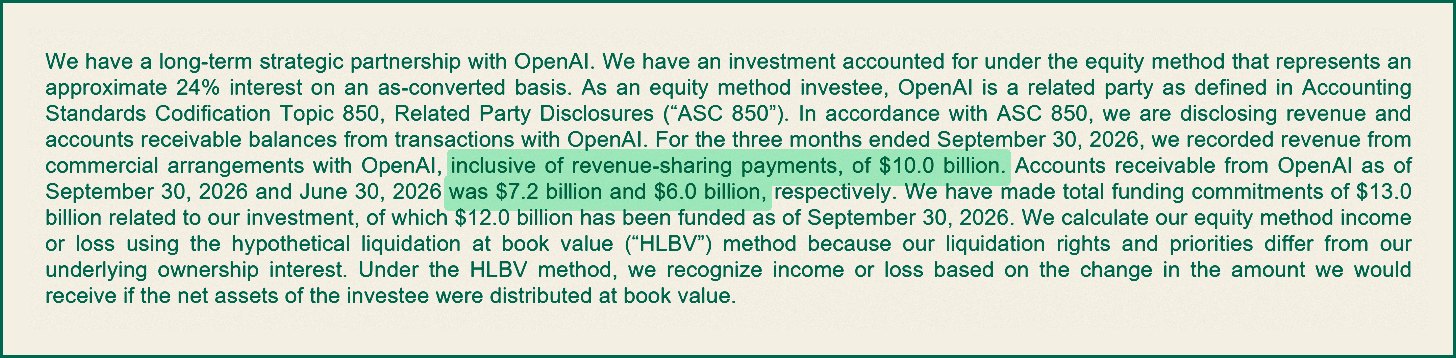
Microsoft billed OpenAI about $10 billion in one quarter. In its quarterly filing for July to September 2026, Microsoft says it recorded $10.0 billion of revenue from its business with OpenAI, including revenue-sharing payments. OpenAI also owed Microsoft $7.2 billion at the end of September, up from $6.0 billion three months earlier. For a sense of scale, the WSJ reported OpenAI's own revenue for April to June at $6.7 billion. The periods do not line up exactly, and Microsoft's number includes its share of OpenAI's sales, but one supplier's bill to OpenAI in a single quarter is now bigger than OpenAI's whole revenue for the quarter before. That is before Oracle, Amazon, Nvidia and the rest get paid.
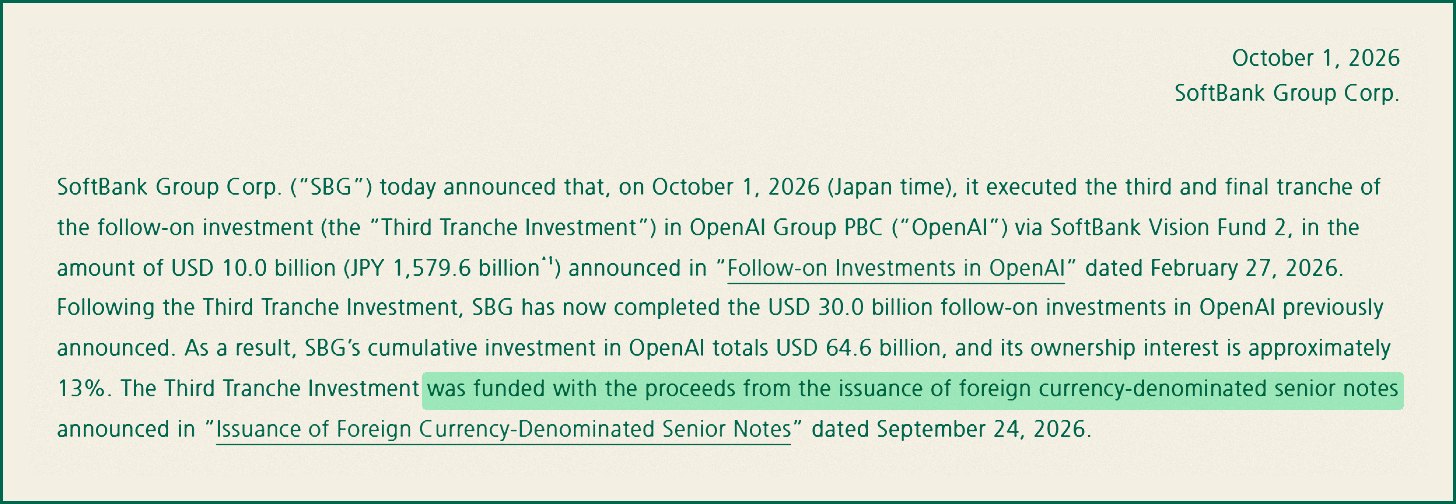
SoftBank paid for OpenAI with borrowed money. SoftBank's own press releases show it paid its $30 billion share of OpenAI's March round in three $10 billion parts. The first two were paid from a bridge loan. The last part, on 1 October, was paid with the money from about $11.1 billion of new bonds sold in September with interest rates between 7.125 and 9.75 percent. Bloomberg called it one of the largest junk bond sales on record. The investor that anchored OpenAI's last big price paid for its stake with expensive debt.
Amazon's money goes in one door and comes back through another. Amazon's filing shows it has now paid all $50 billion it promised OpenAI this year. In the same filing, Amazon says OpenAI expanded its $38 billion cloud deal with Amazon Web Services by another $100 billion over eight years. So Amazon put $50 billion in, and OpenAI has promised to spend about $138 billion on Amazon's cloud.
Amazon has marked up only one of its AI bets. Amazon owns large stakes in both OpenAI and Anthropic. In its filing, Amazon says $62.8 billion of the $62.9 billion it added to the value of its private stakes this year came from Anthropic. As far as its books show, its OpenAI stake has not been marked up at all.
Is OpenAI running out of money?
No, not soon. OpenAI raised $122 billion in its March round, and the FT reported it is on track to use up that money by 2028. That is why this round was called a bridge, not a rescue.
The problem is the size of what comes after. The FT reported in September, from a company presentation, that OpenAI expects about $278 billion of negative free cash flow from 2026 to 2030. Even a full $20 billion round covers about 7 percent of that. The WSJ reported that OpenAI lost $12.3 billion on its operations in April to June, counting stock pay, on $6.7 billion of revenue. Losses grew faster than sales.
OpenAI's chief financial officer, Sarah Friar, told staff in August that OpenAI will be a public company in 2027, or sooner. Sam Altman said in September that listing in 2026 would be "ill-advised". OpenAI needs about a quarter of a trillion dollars more over five years. So it has to come back to investors again and again, and from now on every round gets measured against Anthropic's public numbers.
OpenAI vs Anthropic: who is bigger now?
On revenue, Anthropic. Anthropic's S-1 shows $11.6 billion of revenue in April to June 2026. The WSJ reported OpenAI's at $6.7 billion for the same quarter, about 58 percent of Anthropic's. In the first half of 2026, Anthropic's day-to-day business brought in $3.9 billion more cash than it spent.
There is a fair catch. Anthropic counts sales made through cloud partners like Amazon and Google at the full price, while OpenAI counts its revenue after partners take their share, and OpenAI has complained about this difference. Bloomberg and the FT reported that OpenAI's run rate was about $50 billion a year at the end of September. The higher figure of nearly $70 billion that some had reported came from investors counting OpenAI's sales the way Anthropic counts its own. Nobody has published a fully matched comparison. Anthropic also reported an $80.7 billion net loss for the first half, almost all of it an accounting charge from the rising value of its own securities rather than cash it spent, and it has signed hundreds of billions of dollars in new computing deals. Anthropic is not risk-free. But its numbers are public, and OpenAI's are not.
On Hacker News, the Anthropic S-1 thread drew about 1,700 points and 1,700 comments. The thread on OpenAI's $11 billion drew about 180 points. People are paying attention to the company that showed its work.
What does this mean for ChatGPT users in India?
Nothing in the reports links the funding gap to India directly, so I will put this as a question. India is ChatGPT's second-largest market, with 100 million weekly users, Sam Altman said in February. OpenAI made ChatGPT Go free for a year for people in India who signed up from 4 November 2025. Those free years start to run out on 4 November 2026, three days from now. I found no announcement about what happens next.
OpenAI also signed up as the first customer of TCS's new HyperVault data centre business in India. It starts at 100 megawatts, with plans to grow to 1 gigawatt. A company that has to show investors a path to profit has less room for free plans and slow-paying projects, so watch both.
"$11 billion is still a huge amount of money"
This is the best case for calm, and it is true. Most companies never raise $11 billion in their whole life. OpenAI's price still went up from March. Big rounds often close in parts, and the WSJ says more money is expected in the coming weeks. OpenAI told investors its yearly revenue run rate reached about $50 billion and should hit $70 billion by the end of the year, Reuters reported.
The size of the cheque matters less than the fact that there was a gap at all. A year ago, investors fought to get into OpenAI's rounds. This time, the company set the price, lowered it, then lowered the size, and is now turning to wealthy people and bank clients to finish the job. Reuters said OpenAI met long-only funds in mid-October, and none of them has been named among those putting money in. When the buyers change from the biggest funds to rich families, it tells you how the professionals feel about the price.
What Sam Altman should do
In August 2025, Sam Altman said investors as a whole were "overexcited about AI". He said smart people get overexcited about a kernel of truth. He was right, and this week some of his own investors applied that to his own company.
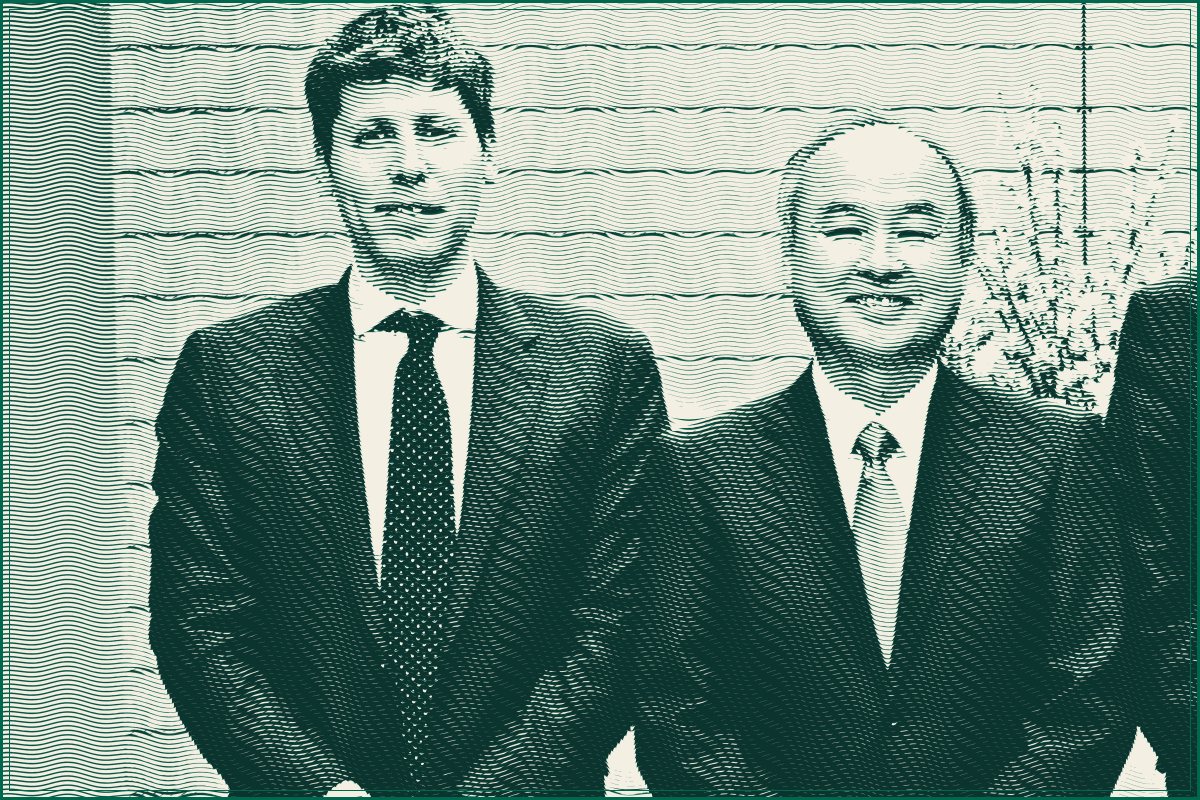
OpenAI should stop pricing its rounds like a public company while it keeps its numbers private. Anthropic showed its revenue, losses and cash flow to everyone, and people paid attention. If OpenAI wants a price above a trillion dollars, it should publish its own checked numbers, counted the same way. Then investors and users can compare like with like.
My prediction
OpenAI will not raise money at a valuation above $1.4 trillion before 30 June 2027. If I am wrong, I will say so here.
My reasons are in the filings. OpenAI's own plan, as reported by the FT, needs about $278 billion more cash than it makes through 2030. Its biggest backers are now paying with borrowed money or getting it back as cloud spending. And from November, every OpenAI price will sit next to Anthropic's public share price, with real numbers behind it.
Questions people are asking
Is the AI bubble bursting? Not in the sense that money is leaving AI. OpenAI's new price is still higher than in March. But investors refused OpenAI's asking price this week, and big tech companies are borrowing and raising money to keep spending, so the easy-money phase is ending.
How much money did OpenAI raise? About $11 billion committed so far, according to the WSJ, toward a round that started at $30 billion and was cut to about $20 billion, at a valuation of about $1.25 trillion. OpenAI expects to raise more in the coming weeks.
Is OpenAI running out of money? Not soon. It raised $122 billion in March, which the FT says it is on track to use up by 2028. But it expects about $278 billion of negative free cash flow from 2026 to 2030, so it will need to raise much more.
What is OpenAI worth now? About $1.25 trillion in this round, down from the $1.4 trillion it first asked for, and up from $852 billion in March 2026.
When is the OpenAI IPO? There is no date. Sam Altman said listing in 2026 would be ill-advised, and CFO Sarah Friar told staff OpenAI will be public in 2027 or sooner.
Is Anthropic bigger than OpenAI? By revenue in April to June 2026, yes: $11.6 billion for Anthropic against $6.7 billion reported for OpenAI. The two count some revenue differently, so the real gap is smaller than those numbers suggest.
Sources 31
- The Wall Street Journal, Berber Jin, OpenAI raises less than half of $30 billion target in latest round, 30 Oct 2026:wsj.com/tech/…
- Financial Times, OpenAI slashes funding target by $10bn as tech anxieties mount, 30 Oct 2026:ft.com/content/…
- Financial Times, OpenAI trims valuation target to $1.25tn after pitching higher price, 22 Oct 2026:ft.com/content/…
- Bloomberg, OpenAI targets $30 billion in new funding at $1.4 trillion value, 29 Sep 2026:bloomberg.com/news/…
- Bloomberg via Business Standard, OpenAI in talks with UAE funds, BlackRock for $30 billion funding round, 6 Oct 2026:business-standard.com/world-news/…
- CNBC, OpenAI nears up to $30 billion funding round at $1.25 trillion valuation led by UAE investors, 22 Oct 2026:cnbc.com/2026/…
- Reuters via The Star, Exclusive: OpenAI seeks to accelerate fundraising ahead of Anthropic IPO, 20 Oct 2026:thestar.com.my/tech/…
- Reuters via The Star, OpenAI forecasts cash burn near $280 billion by 2030, FT reports, 19 Sep 2026:thestar.com.my/tech/…
- The Next Web, OpenAI cuts its funding round to $20bn after raising $11bn, WSJ reports, 31 Oct 2026:thenextweb.com/news/…
- Fortune, Jason Ma, AI boom hits a wall on Wall Street as OpenAI cuts fundraising target, 31 Oct 2026:fortune.com/2026/…
- Microsoft, Form 10-Q for the quarter ended 30 Sep 2026:sec.gov/Archives/…
- Microsoft, Form 10-K for the year ended 30 Jun 2026:sec.gov/Archives/…
- SoftBank Group, Follow-on investments in OpenAI, 27 Feb 2026:group.softbank/en/…
- SoftBank Group, Issuance of foreign currency-denominated senior notes, 24 Sep 2026:group.softbank/en/…
- SoftBank Group, Execution of follow-on investment (third tranche) in OpenAI, 1 Oct 2026:group.softbank/en/…
- Business Today, SoftBank plans $11 billion junk bond sale to fuel OpenAI bet, 21 Sep 2026:businesstoday.in/markets/…
- Amazon, Form 10-Q for the quarter ended 30 Sep 2026:sec.gov/Archives/…
- Anthropic, Form S-1, filed 26 Oct 2026:sec.gov/Archives/…
- Alphabet, Q3 2026 earnings release, 28 Oct 2026:sec.gov/Archives/…
- Business Day (Reuters), Meta plans to raise up to $95bn in equity, 26 Oct 2026:businessday.co.za/world/…
- investingLive, Americas FX news wrap 30 Oct: Nasdaq tumbles as AI costs worry investors, 30 Oct 2026:investinglive.com/news/…
- Outlook Business, OpenAI trails Anthropic in Q2 revenue as growth slows and losses deepen, 19 Aug 2026:outlookbusiness.com/deeptech/…
- Bloomberg Law, OpenAI's revenue run rate nears $50 billion, less than reported, 8 Oct 2026:news.bgov.com/artificial-intelligence/…
- AI Weekly, OpenAI CFO Sarah Friar tells staff company will be public in 2027 or sooner, 19 Aug 2026:aiweekly.co/alerts/…
- Khaleej Times (Reuters), OpenAI's Altman won't do IPO this year, 13 Sep 2026:khaleejtimes.com/openais-altman-wont-do-ipo-this-year-calls-ai-extinction-risk-unacceptable
- Business Today, Investors are overexcited about AI, says OpenAI CEO Sam Altman, 20 Aug 2025:businesstoday.in/amp/…
- TechCrunch, India has 100M weekly active ChatGPT users, Sam Altman says, 15 Feb 2026:techcrunch.com/2026/…
- TechCrunch, OpenAI taps Tata for 100MW AI data center capacity in India, eyes 1GW, 18 Feb 2026:techcrunch.com/2026/…
- Business Today, ChatGPT Go free for Indians for one year, starting Nov 4, 28 Oct 2025:businesstoday.in/technology/…
- Hacker News, OpenAI raises less than half of $30B target, 31 Oct 2026:news.ycombinator.com/item
- Hacker News, Anthropic S-1, Oct 2026:news.ycombinator.com/item