Sam Altman changed his name on X to Ram Altman. A stranger asked him to on 4 November, he wrote back "ok yeah", and that two-word reply passed 1.9 million views, about four and a half times more than the post where he explained himself. It is a good joke. But it is a joke about something that has made a 32GB kit of computer memory go from $100 to $200 a year ago to about $450 to $500 now, and I don't want the joke to make us forget that part.
Here is the short version. On a podcast released on 29 October, the head of OpenAI said it is "quite terrible" that so much of the world's memory sits inside people's own computers. People were furious, Elon Musk posted a meme, and Altman now says he was taken out of context and that he wants you to have more RAM, not less. I read the full podcast, his posts and what the three companies that make almost all of the world's memory told their investors in the last six weeks. He is right that he was clipped. He is wrong that your computer is the problem. And the shortage he is talking about is going to get worse before it gets better.
What did Sam Altman say about RAM?
He said it on Cheeky Pint, the interview show hosted by Stripe's John Collison. Collison asked how the market was fixing the high prices of memory and chips. Altman's first answer was one word, "Bad", and then he said, "I think the invisible hand is failing right now."
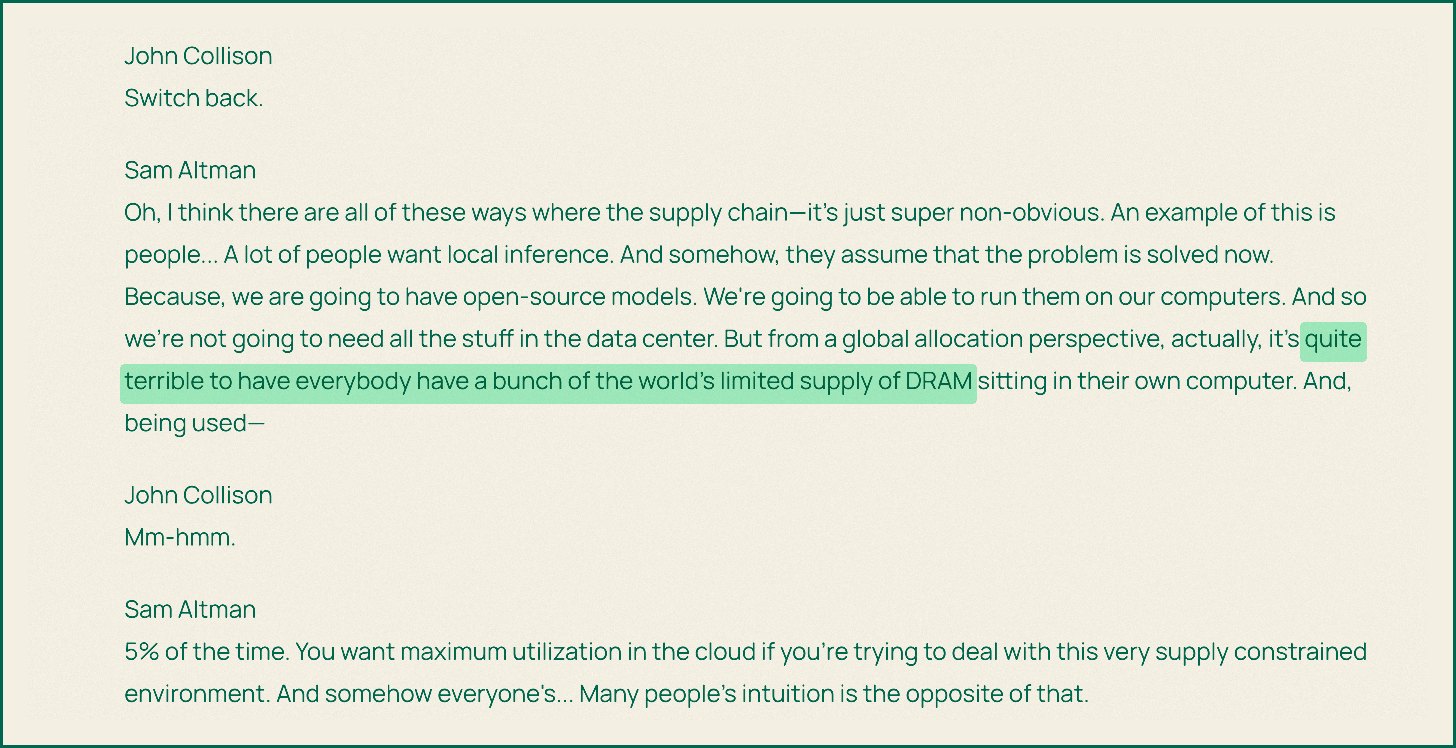
A few minutes later he got to the line everyone clipped. He was answering a common idea, that because we will have open-source AI models that run on our own computers, the world will not need so many data centers. This is what he said, from the show's own transcript:
"But from a global allocation perspective, actually, it's quite terrible to have everybody have a bunch of the world's limited supply of DRAM sitting in their own computer. And, being used... 5% of the time. You want maximum utilization in the cloud if you're trying to deal with this very supply constrained environment."
DRAM is the working memory in every computer, phone and console, the thing we all call RAM. The 5 percent figure is his own. He did not say where it came from.
Why did Sam Altman change his name to Ram Altman?
Because the internet would not let it go, and he decided to laugh with it. On 1 November (early on 2 November in India), Elon Musk posted "The people deserve to have their RAM too!" with a picture of the officer from Inglourious Basterds asking if you are withholding DRAM from the cloud. That post has passed 4.8 million views.
On 4 November an X user asked Altman, "why u want my ram then". He answered, "i want you to have so much ram, lets build more". A few hours later another user asked him to rename his account to Ram Altman. He said "ok yeah", changed it, and then explained himself. He wrote that he did it because he wants the world to have tons of memory and people to put as much as they want in their computers, that it was annoying to see his words taken out of context, and that he has been arguing for the world to ramp up memory production for a long time. He used a stronger word than annoying.
In India the joke took off in its own way. With the new Ramayana film coming out and Diwali days away, people turned "Ram Altman" into Ramayana memes. It is the best thing that has happened to his replies all year.
Get the next story by email. One short email every Friday. Free, unsubscribe in one click.
Was Sam Altman taken out of context?
Partly, yes, and I want to be fair to him here because most of the clips were not. In the same interview he said chips will only get cheaper if "supply's got to go way up", and he said that if prices don't come down, "I'll be very sad." Collison summed up his view as wanting a world with so much memory that anyone who wants a computer can have one. That is not a man who wants to take your laptop.
He also explained why memory makers won't build fast enough. For decades, he said, a DRAM maker would "invest $20 billion of CapEx to make $19 billion", go through booms and busts, and nearly go bankrupt building too many factories. Now they are making fortunes and they remember their history. That part is true, and it is the most useful thing he said.
Still, the clipped line is not a misquote. He did say it is "quite terrible" for the world's memory to sit in your computer, and he said it while arguing that running AI on your own machine will not replace his data centers. His posts this week say he wants you to have more RAM. They do not say he was wrong that your RAM would do more good in his data center. He kept that part.
Is Sam Altman responsible for the RAM shortage?
Not alone, but his company is near the front of the line. On 1 October 2025, OpenAI announced that Samsung and SK hynix would join its Stargate data center project and were targeting 900,000 DRAM wafer starts a month. A wafer is the thin disc that memory chips are cut from. Reports at the time, picked up by TrendForce, the research firm that tracks memory prices, estimated that could be as much as 40 percent of the world's DRAM output. Think of one bakery ordering 40 percent of the world's flour. Every other baker pays more, even if the bakery never uses all of it.
There is a detail in that deal almost nobody mentions. Reporting since then, including by The Deep Dive in March, says those agreements were letters of intent with no firm obligation for OpenAI to buy everything. OpenAI never said what it ordered. So the most famous number in this shortage, the one that scared the whole market, is a target, not a bill.
The bigger cause is the kind of memory AI needs. AI chips use high-bandwidth memory, called HBM, and Micron says each gigabyte of it uses roughly three times the wafer area of the normal DDR5 RAM in your PC. HBM pays far more, so Samsung, SK hynix and Micron, the three companies that make almost all of the world's DRAM, moved their factories toward it. Micron went further. In December 2025 it announced it was leaving the Crucial business, its RAM and SSD brand for regular buyers, saying demand from AI data centers had surged. Crucial shipments ended in February 2026. One of the three makers stopped selling to you.
Now look at what that did for them. SK hynix reported an operating profit of about 83 trillion won in July to September 2026, an 80 percent margin on its sales. Samsung reported a record quarter. Micron's DRAM sales were up 343 percent from a year earlier. When Altman said these companies were each about to make about $100 billion of free cash flow in a year, he was not exaggerating. The shortage is the best thing that has ever happened to them, and that is exactly why I name them along with OpenAI. The people who built the shortage and the people getting rich from it sit at the same table.
Why is RAM so expensive in 2026?
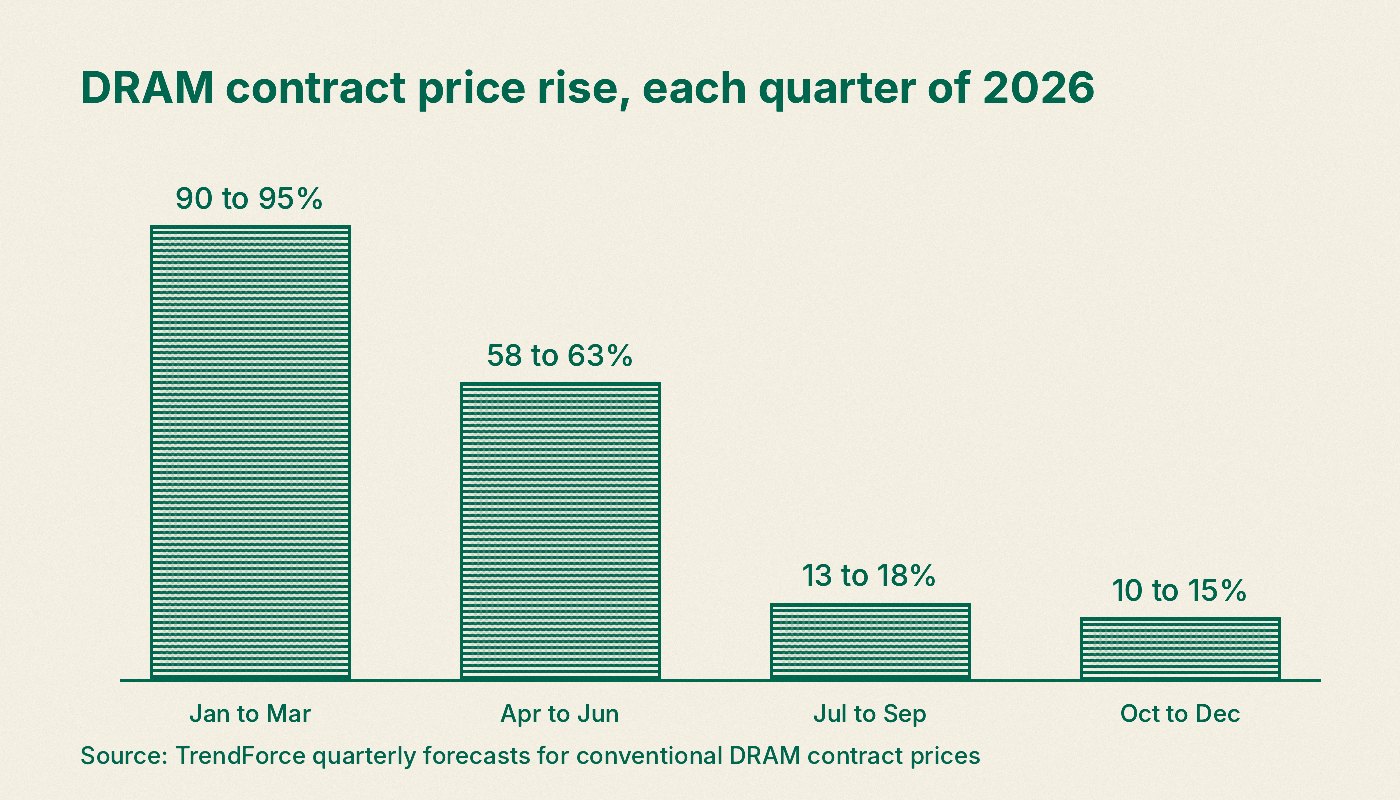
Because the makers raised the price they charge for normal RAM, again and again, all year. TrendForce's own forecasts for contract prices, the price PC and phone makers pay in bulk, say it all:
- January to March 2026: up 90 to 95 percent, and over 100 percent for PC memory, a record.
- April to June: up another 58 to 63 percent.
- July to September: up another 13 to 18 percent.
- October to December: up another 10 to 15 percent.
On the shelf, Engadget found that a 32GB kit of DDR5, the RAM in new PCs, cost $100 to $200 in October 2025 and about $454 in October 2026. RAMRadar's lowest tracked price for a common 32GB DDR5 kit was about $506 on 4 November. A 16GB kit of older DDR4 RAM that cost $60 in 2020 costs about $104.
What the RAM shortage costs you, even if you never buy RAM
You pay for it every time you buy anything with a chip in it. Memory and storage went from about 15 percent of a PC's cost to nearly 40 percent, according to the research firm Omdia, as reported by Windows Latest. These are the price rises companies made this year, from their own announcements and the outlets that covered them:
- Sony raised the PS5 from $549.99 to $649.99 and the PS5 Pro from $749.99 to $899.99 in April.
- Microsoft raised the Xbox Series X to $799 in August, its third rise in 15 months, and TechSpot reported that Microsoft now pays about two and a half times as much for memory.
- Nintendo raised the Switch 2 from $449.99 to $499.99 in September, pointing to changes in market conditions, including component costs.
- Valve raised the Steam Deck OLED 512GB from $549 to $789 in May.
- Raspberry Pi raised prices twice, saying memory has risen steeply.
- Apple's Tim Cook confirmed in June that Apple would raise prices because of memory and storage costs.
And people stopped buying. IDC counted PC shipments down about 20 percent from a year earlier in July to September 2026, Windows Latest reported. This worries me more than any console price. A whole generation of students and hobbyists is being priced out of building their first computer, because the memory went somewhere else.
What the RAM shortage means for India
India feels this harder than most places, because so many people here buy phones at the bottom of the price list. Counterpoint found that the average smartphone price in India rose about 16 percent in the first half of 2026, and phones under ₹10,000 rose about 32 percent. Shipments of those phones fell 65 percent from a year earlier. That is not people choosing to wait for a better phone. That is people who can no longer afford their first one.
Laptops went the same way. ASUS India said in April it expected prices to rise 20 to 30 percent in that quarter alone. And if you are building a PC, a 32GB DDR5 kit costs about ₹57,000 to ₹61,000 on PC Prices India, more than many people here earn in a month.
So when Indians spent this week wishing Ram Altman a happy Diwali, the joke had a sting in it. Many of the same people are the ones paying for this shortage.
The local AI part nobody is saying
Here is the part of this story I find the most telling. In August 2025, OpenAI released its own open model, gpt-oss-20b, and its launch post said it "can run on edge devices with just 16 GB of memory", for "on-device use cases, local inference". That is AI running on your own computer, with your own RAM. OpenAI sold it as a feature. This October its chief executive called the same idea "quite terrible" for the world's memory.
Running AI on your own machine matters for normal people for three reasons. Your chats stay on your computer. Nobody can cut you off. And nobody can raise the price on you next year. On Hacker News, people in the thread about his comments said they run local models for privacy and worried about a rug pull, where a company changes the deal after you depend on it. That fear is fair. If the only place memory is allowed to live is a few companies' data centers, then a few companies decide what AI costs.
The best case for Altman, and why I still disagree
Altman's defenders have a real point. Most of the time your computer is not doing much, and a data center can share one machine's memory across thousands of people. Cloud computing was invented for exactly this. If the world has a fixed amount of memory, putting it where it is used the most is not a crazy idea.
The RAM in your computer is not sitting there doing nothing. Your operating system fills spare memory with cache so your apps open faster, which is why your RAM always looks busy. Value is also not the same as use. My fire extinguisher is used 0 percent of the time, and I still want it in my house. And the amount of memory in the world is not fixed by nature. It is fixed by three companies deciding how many factories to build. The answer to a shortage is more memory, which Altman himself said in the same interview, not less memory in your home.
Will RAM prices go down?
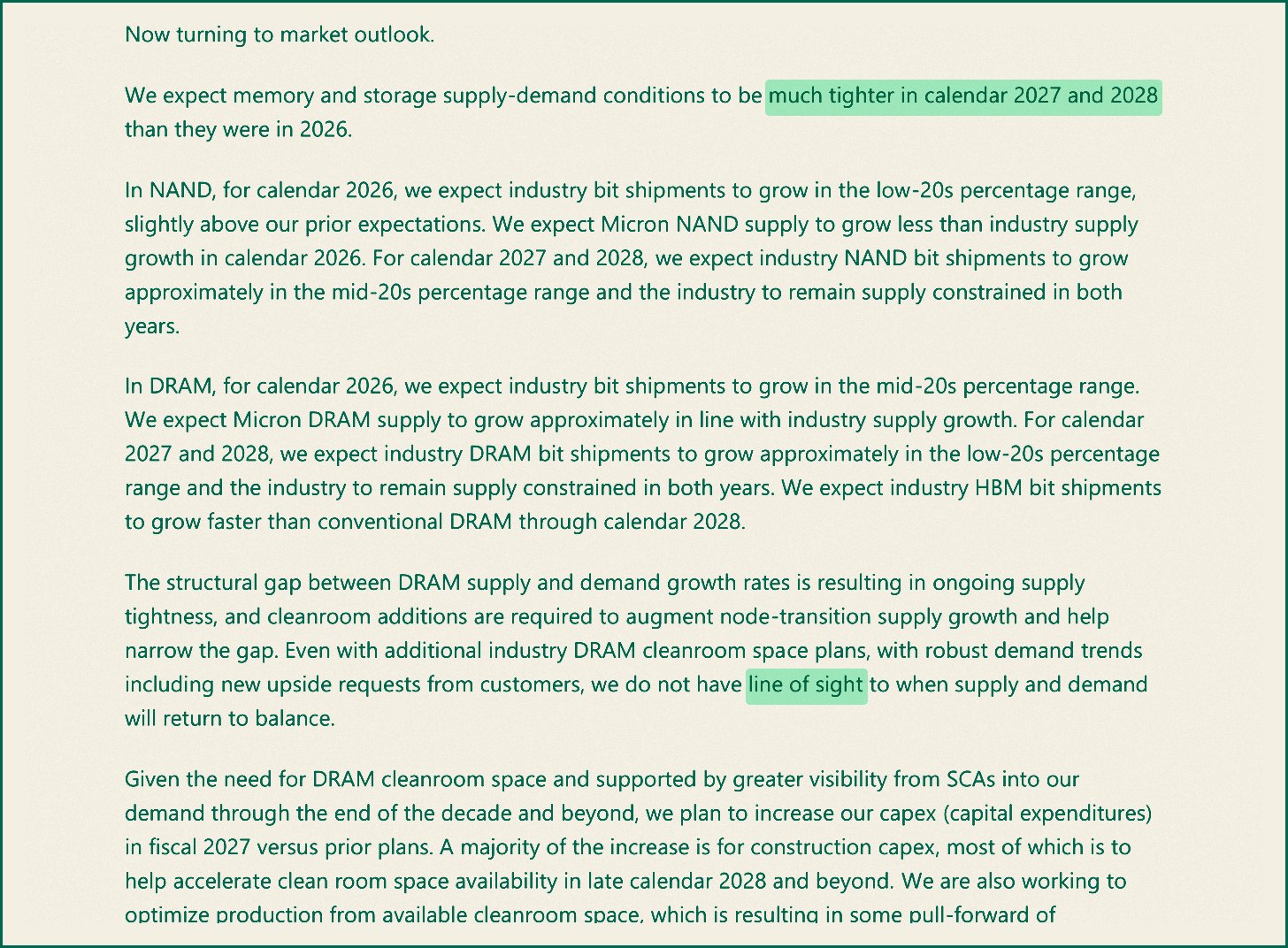
Not soon, and I would plan around that. The three makers told investors this in their own words in the last six weeks:
- Micron said on 30 September that supply will be "much tighter in calendar 2027 and 2028" and that "we do not have line of sight to when supply and demand will return to balance."
- SK hynix said on its 27 October earnings call that its DRAM and HBM for the next three years, through 2029, are "effectively sold out", and that it expects PC and phone shipments to fall because of the cost.
- Samsung said AI demand next year will far exceed the industry's supply, even compared with 2026.
New factories are coming, but slowly. Micron's new Idaho factory starts producing in mid-2027, and its second one in late 2028. TrendForce also warns that the supply of PC memory could fall in 2027, as more of it moves to servers.
My prediction: on 1 July 2027, the cheapest 32GB DDR5 desktop kit on PCPartPicker in the US will still cost more than $300. If I am wrong, I will say so here.
Should you buy RAM now or wait?
If you need RAM in the next year, buy it now and stop waiting for a drop. Every company that makes it says 2027 will be tighter. Watch a price tracker and buy when your kit is near its lowest tracked price. Last year Engadget found there were no real Black Friday deals on RAM, and supply is tighter now, so don't hold out for one.
If you are on a budget, look at DDR4. It is older and slower, but a used 32GB DDR4 kit was going for about $139 on eBay in September, a fraction of DDR5. If you want to run AI on your own machine, 16GB is enough for small models like gpt-oss-20b. You don't need 128GB to start.
And whatever you buy, keep it. The man who runs OpenAI now says he wants you to have so much RAM. I believe he wants the world to make more. I don't think we should give up the memory we already have while we wait for him.
Questions people are asking
/01What did Sam Altman say about RAM?
He said on the Cheeky Pint podcast, released on 29 October 2026, that it is "quite terrible to have everybody have a bunch of the world's limited supply of DRAM sitting in their own computer" and being used about 5 percent of the time, and that you want maximum use in the cloud while memory is short.
/02Why did Sam Altman change his name to Ram Altman?
An X user asked him to rename his account on 4 November 2026 and he said "ok yeah". He said he did it because he wants the world to have tons of memory and that his podcast comment was taken out of context.
/03Is Sam Altman responsible for the RAM shortage?
OpenAI is a big part of it. Its 2025 Stargate deals with Samsung and SK hynix targeted 900,000 DRAM wafer starts a month, which reports estimated could be up to 40 percent of world output. The wider cause is that all AI companies want high-bandwidth memory, and the makers moved their factories to it.
/04When will RAM prices go down?
Not soon. Micron expects supply to be much tighter in 2027 and 2028 and has no date for balance, and SK hynix says it is effectively sold out through 2029.
/05Is it a good time to buy RAM?
If you need it within a year, yes. Buy near the lowest tracked price for your kit instead of waiting for a sale.
/06Does running AI on my own computer need a lot of RAM?
Not to start. OpenAI says its own gpt-oss-20b model runs on devices with 16GB of memory.
Sources 38
- Cheeky Pint #39, Why Sam Altman is against a single superintelligence, transcript, 29 Oct 2026:cheekypint.transistor.fm/39/…
- Cheeky Pint #39 on YouTube, 29 Oct 2026:youtube.com/watch
- Sam Altman on X, i want you to have so much ram, 4 Nov 2026:x.com/sama/…
- Sam Altman on X, ok yeah, 4 Nov 2026:x.com/sama/…
- Sam Altman on X, taken out of context, 4 Nov 2026:x.com/sama/…
- Elon Musk on X, The people deserve to have their RAM too!, 1 Nov 2026:x.com/elonmusk/…
- OpenAI, Samsung and SK join OpenAI's Stargate initiative, 1 Oct 2025:openai.com/index/…
- TrendForce, OpenAI's Stargate 900K DRAM wafers could hit 40% of global output, 2 Oct 2025:trendforce.com/news/…
- The Deep Dive, OpenAI locked up 40% of global RAM with no obligation to buy any of it, 31 Mar 2026:thedeepdive.ca/openai-locked-up-40-of-global-ram-with-no-obligation-to-buy-any-of-it
- Tom's Hardware, Micron says the silicon gap between HBM and DDR5 is widening, 23 Aug 2026:tomshardware.com/tech-industry/…
- Game Developer, Nintendo is raising Switch 2 prices around the world:gamedeveloper.com/business/…
- OpenAI, Introducing gpt-oss, 5 Aug 2025:openai.com/index/…
- Micron, Fiscal Q4 2026 prepared remarks, 30 Sep 2026:s25.q4cdn.com/621799436/…
- Micron, exit from the Crucial consumer business, via StorageNewsletter, 5 Dec 2025:storagenewsletter.com/2025/…
- SK hynix Q3 2026 earnings call (27 Oct) transcript, The Motley Fool, 28 Oct 2026:fool.com/earnings/…
- Samsung Electronics, third quarter 2026 results, Oct 2026:news.samsung.com/global/…
- TrendForce, 1Q26 DRAM contract price forecast, 2 Feb 2026:trendforce.com/presscenter/…
- TrendForce, 2Q26 DRAM contract price forecast, 31 Mar 2026:trendforce.com/presscenter/…
- TrendForce, 3Q26 DRAM contract price forecast, 3 Jul 2026:trendforce.com/presscenter/…
- TrendForce, 4Q26 DRAM contract price forecast, 30 Sep 2026:trendforce.com/presscenter/…
- Engadget, How much RAM cost in 2020 vs 2026, 2 Nov 2026:engadget.com/2300341/…
- Engadget, There aren't any Black Friday deals on RAM this year, 28 Nov 2025:engadget.com/ai/…
- RAMRadar, Should I buy RAM now?, checked 4 Nov 2026:ramradar.app/guides/…
- PC Gamer, Sam Altman argues that it's bad you want DRAM in your computer, 30 Oct 2026:pcgamer.com/software/…
- Tom's Hardware, Elon Musk mocks Sam Altman's claim that PCs having RAM is terrible, 2 Nov 2026:tomshardware.com/tech-industry/…
- Washington Times, Sony hikes PS5 to $600, PS5 Pro to $900, 27 Mar 2026:m.washingtontimes.com/news/…
- TechSpot, Third Xbox price hike in 15 months:techspot.com/news/…
- Game Informer, Valve raised the price of the Steam Deck, 27 May 2026:gameinformer.com/2026/…
- Raspberry Pi, More memory-driven price rises, 2 Feb 2026:raspberrypi.com/news/…
- TidBITS, Tim Cook confirms Apple will raise prices due to memory and storage costs, 18 Jun 2026:tidbits.com/2026/…
- IDC, PC market enters volatile territory as memory shortage persists through 2027, 2 Jun 2026:idc.com/resource-center/…
- Windows Latest, PC shipments crashed 20% as AI eats the world's RAM, 11 Oct 2026:windowslatest.com/2026/…
- Digit, Smartphone prices surge in India as memory costs soar, 29 Sep 2026:digit.in/news/…
- Outlook Business, ASUS sees laptop prices rising by as much as 45% in 2026, 16 Apr 2026:outlookbusiness.com/corporate/…
- PC Prices India, RAM prices in India 2026, checked 3 Nov 2026:pcpricesindia.in/news/…
- Free Press Journal, Sam Altman becomes Ram Altman on X, sparks Ramayana memes, Nov 2026:freepressjournal.in/tech/…
- Hacker News, Sam Altman Thinks You're Wasting DRAM, Oct 2026:news.ycombinator.com/item
- Hacker News, Sam Altman says DRAM capacity should go to data centers, not personal computers, Nov 2026:news.ycombinator.com/item